


Page 146 - Read Online
P. 146
Wang et al. Cancer Drug Resist. 2026;9:8                                         Page 13 of 18


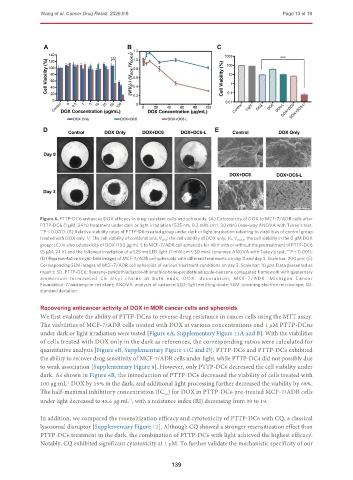
               Figure 6. PTTP-DC6 enhances DOX efficacy in drug-resistant cells and spheroids. (A) Cytotoxicity of DOX to MCF-7/ADR cells after
               PTTP-DC6 (1 μM, 24 h) treatment under dark or light irradiation (525 nm, 0.2 mW·cm , 30 min) (one-way ANOVA with Tukey’s test,
                                                                          -2
               *** P < 0.001); (B) Relative viability rates of PTTP-D6-treated group under dark or light irradiation referring to viabilities of control group
               treated with DOX only. V: The cell viability of combinations, V DOX : the cell viability of DOX only, V0, V DOX,0 : the cell viability in the 0 μM DOX
               group; (C) In vitro cytotoxicity of DOX (100 μg·mL ) to MCF-7/ADR cell spheroids for 48 h with or without the pretreatment of PTTP-DC6
                                                -1
               (5 μM, 24 h) and the followed irradiation of a 525 nm LED light (1 mW·cm , 30 min) (one-way ANOVA with Tukey’s test,  P < 0.001);
                                                                 -2
                                                                                                  ***
               (D) Representative bright-field images of MCF-7/ADR cell spheroids with different treatments on day 0 and day 3. Scale bar: 200 µm; (E)
               Corresponding SEM images of MCF-7/ADR cell spheroids of various treatment conditions on day 3. Scale bar: 10 µm. Data presented as
               mean ± SD. PTTP-DC6: Benzene-pyridothiadiazole-thienothiophene-pyridothiadiazole-benzene conjugated framework with quaternary
               ammonium-terminated   C6   alkyl   chains   at   both   ends;   DOX:   doxorubicin;   MCF-7/ADR:   Michigan   Cancer
               Foundation-7/adriamycin-resistant; ANOVA: analysis of variance; LED: light emitting diode; SEM: scanning electron microscope; SD:
               standard deviation.

               Recovering anticancer activity of DOX in MDR cancer cells and spheroids
               We first evaluate the ability of PTTP-DCns to reverse drug resistance in cancer cells using the MTT assay.
               The viabilities of MCF-7/ADR cells treated with DOX at various concentrations and 1 μM PTTP-DCns
               under dark or light irradiation were tested [Figure 6A, Supplementary Figure 11A and B]. With the viabilities
               of cells treated with DOX only in the dark as references, the corresponding ratios were calculated for
               quantitative analysis [Figure 6B, Supplementary Figure 11C and D]. PTTP-DC6 and PTTP-DC8 exhibited
               the ability to recover drug sensitivity of MCF-7/ADR cells under light, while PTTP-DC4 did not possibly due
               to weak association [Supplementary Figure 8]. However, only PTTP-DC6 decreased the cell viability under
               dark. As shown in Figure 6B, the introduction of PTTP-DC6 decreased the viability of cells treated with
               100 μg·mL  DOX by 19% in the dark, and additional light processing further decreased the viability by 68%.
                       -1
               The half-maximal inhibitory concentration (IC ) for DOX in PTTP-DC6 pre-treated MCF-7/ADR cells
                                                        50
               under light decreased to 48.6 μg·mL , with a resistance index (RI) decreasing from 39 to 19.
                                             -1
               In addition, we compared the resensitization efficacy and cytotoxicity of PTTP-DC6 with CQ, a classical
               lysosomal disruptor [Supplementary Figure 12]. Although CQ showed a stronger resensitization effect than
               PTTP-DC6 treatment in the dark, the combination of PTTP-DC6 with light achieved the highest efficacy.
               Notably, CQ exhibited significant cytotoxicity at 1 μM. To further validate the mechanistic specificity of our


                                                           139

