


Page 14 - Read Online
P. 14
Liu et al. Art Int Surg 2024;4:92-108  https://dx.doi.org/10.20517/ais.2024.19                                                                  Page 98

               We trained our MLP-mixer model for 200 epochs with a learning rate of 1e-4, batch size of 16, and an
                                                  [26]
               Adam Optimizer with default parameters . During training, we selected best-performing models based on
               the reported F1 score during validation at the end of each training epoch. We ceased training if this metric
               did not improve over 50 epochs. Training was performed on a single GeForce RTX 2080 and completed in
               approximately one hour.

               Evaluation metrics
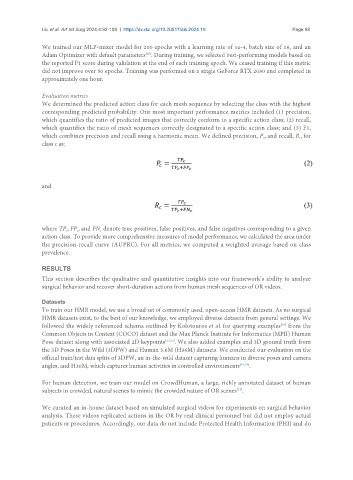
               We determined the predicted action class for each mesh sequence by selecting the class with the highest
               corresponding predicted probability. Our most important performance metrics included (1) precision,
               which quantifies the ratio of predicted images that correctly conform to a specific action class; (2) recall,
               which quantifies the ratio of mesh sequences correctly designated to a specific action class; and (3) F1,
               which combines precision and recall using a harmonic mean. We defined precision, P , and recall, R , for
                                                                                                      c
                                                                                          c
               class c as:


               and


               where TP , FP , and FN  denote true positives, false positives, and false negatives corresponding to a given
                                   c
                       c
                           c
               action class. To provide more comprehensive measures of model performance, we calculated the area under
               the precision-recall curve (AUPRC). For all metrics, we computed a weighted average based on class
               prevalence.

               RESULTS
               This section describes the qualitative and quantitative insights into our framework’s ability to analyze
               surgical behavior and recover short-duration actions from human mesh sequences of OR videos.

               Datasets
               To train our HMR model, we use a broad set of commonly used, open-access HMR datasets. As no surgical
               HMR datasets exist, to the best of our knowledge, we employed diverse datasets from general settings. We
               followed the widely referenced schema outlined by Kolotouros et al. for querying examples  from the
                                                                                                [16]
               Common Objects in Context (COCO) dataset and the Max Planck Institute for Informatics (MPII) Human
               Pose dataset along with associated 2D keypoints [17,27] . We also added examples and 3D ground truth from
               the 3D Poses in the Wild (3DPW) and Human 3.6M (H36M) datasets. We conducted our evaluation on the
               official train/test data splits of 3DPW, an in-the-wild dataset capturing humans in diverse poses and camera
               angles, and H36M, which captures human activities in controlled environments [18,19] .


               For human detection, we train our model on CrowdHuman, a large, richly annotated dataset of human
                                                                                 [13]
               subjects in crowded, natural scenes to mimic the crowded nature of OR scenes .

               We curated an in-house dataset based on simulated surgical videos for experiments on surgical behavior
               analysis. These videos replicated actions in the OR by real clinical personnel but did not employ actual
               patients or procedures. Accordingly, our data do not include Protected Health Information (PHI) and do

