


Page 17 - Read Online
P. 17
Page 101                                                                Liu et al. Art Int Surg 2024;4:92-108  https://dx.doi.org/10.20517/ais.2024.19

               Table 3. Performance of our multi-class classification model observed when we ablate the inclusion of key individual joints that are
               central to modeling lower-arm orientations and computing visual attention
                Pelvic joints      Arm joints        Cranial joints
                All           Wrists   Elbows   Eyes   Head   Ears  Recall↑  Precision↑   F1↑  AUPRC↑
                √             √        -        -      -      -     0.77     0.74         0.75  0.78
                √             √        √        -      -      -     0.73     0.72         0.72  0.78
                √             √        √        √      -      -     0.80     0.79         0.79  0.80
                √             √        √        √      √      -     0.79     0.79         0.79  0.82
                √             √        √        √      √      √     0.83     0.82         0.81  0.85
                -             √        √        √      √      √     0.77     0.75         0.76  0.82
               Embeddings are modeled as 3D joint positions. Bolding indicates a top score. AUPRC: The area under the precision-recall curve.


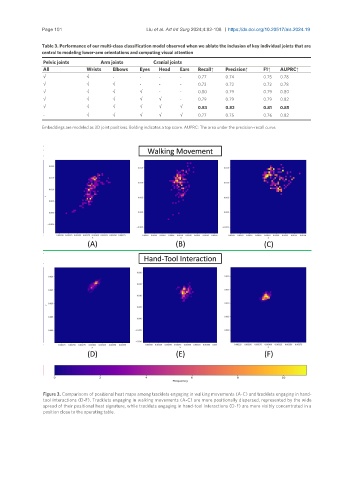
                Figure 3. Comparisons of positional heat maps among tracklets engaging in walking movements (A-C) and tracklets engaging in hand-
                tool interactions (D-F). Tracklets engaging in walking movements (A-C) are more positionally dispersed, represented by the wide
                spread of their positional heat signature, while tracklets engaging in hand-tool interactions (D-F) are more visibly concentrated in a
                position close to the operating table.

