


Page 18 - Read Online
P. 18
Liu et al. Art Int Surg 2024;4:92-108  https://dx.doi.org/10.20517/ais.2024.19                                                                Page 102


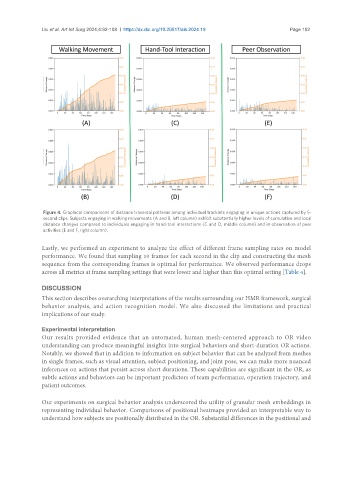
                Figure 4. Graphical comparisons of distance traversal patterns among individual tracklets engaging in unique actions captured by 5-
                second clips. Subjects engaging in walking movements (A and B, left column) exhibit substantially higher levels of cumulative and local
                distance changes compared to individuals engaging in hand-tool interactions (C and D, middle column) and in observation of peer
                activities (E and F, right column).

               Lastly, we performed an experiment to analyze the effect of different frame sampling rates on model
               performance. We found that sampling 10 frames for each second in the clip and constructing the mesh
               sequence from the corresponding frames is optimal for performance. We observed performance drops
               across all metrics at frame sampling settings that were lower and higher than this optimal setting [Table 4].


               DISCUSSION
               This section describes overarching interpretations of the results surrounding our HMR framework, surgical
               behavior analysis, and action recognition model. We also discussed the limitations and practical
               implications of our study.


               Experimental interpretation
               Our results provided evidence that an automated, human mesh-centered approach to OR video
               understanding can produce meaningful insights into surgical behaviors and short-duration OR actions.
               Notably, we showed that in addition to information on subject behavior that can be analyzed from meshes
               in single frames, such as visual attention, subject positioning, and joint pose, we can make more nuanced
               inferences on actions that persist across short durations. These capabilities are significant in the OR, as
               subtle actions and behaviors can be important predictors of team performance, operation trajectory, and
               patient outcomes.


               Our experiments on surgical behavior analysis underscored the utility of granular mesh embeddings in
               representing individual behavior. Comparisons of positional heatmaps provided an interpretable way to
               understand how subjects are positionally distributed in the OR. Substantial differences in the positional and

