


Page 11 - Read Online
P. 11
Page 95                                                                  Liu et al. Art Int Surg 2024;4:92-108  https://dx.doi.org/10.20517/ais.2024.19


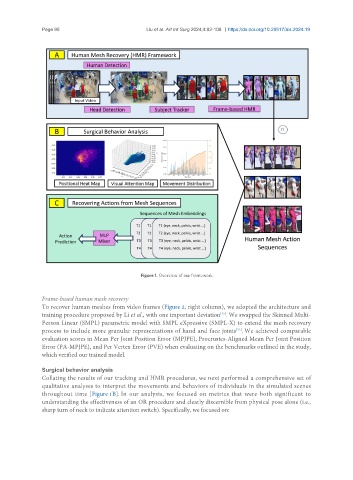
                                                 Figure 1. Overview of our framework.


               Frame-based human mesh recovery
               To recover human meshes from video frames (Figure 2, right column), we adopted the architecture and
               training procedure proposed by Li et al., with one important deviation . We swapped the Skinned Multi-
                                                                           [15]
               Person Linear (SMPL) parametric model with SMPL eXpressive (SMPL-X) to extend the mesh recovery
               process to include more granular representations of hand and face joints . We achieved comparable
                                                                                 [21]
               evaluation scores in Mean Per Joint Position Error (MPJPE), Procrustes-Aligned Mean Per Joint Position
               Error (PA-MPJPE), and Per Vertex Error (PVE) when evaluating on the benchmarks outlined in the study,
               which verified our trained model.

               Surgical behavior analysis
               Collating the results of our tracking and HMR procedures, we next performed a comprehensive set of
               qualitative analyses to interpret the movements and behaviors of individuals in the simulated scenes
               throughout time [Figure 1B]. In our analysis, we focused on metrics that were both significant to
               understanding the effectiveness of an OR procedure and clearly discernible from physical pose alone (i.e.,
               sharp turn of neck to indicate attention switch). Specifically, we focused on:

