


Page 22 - Read Online
P. 22
Page 4 of 8                                                   Lee et al. Vessel Plus 2021;5:8  I  http://dx.doi.org/10.20517/2574-1209.2020.72

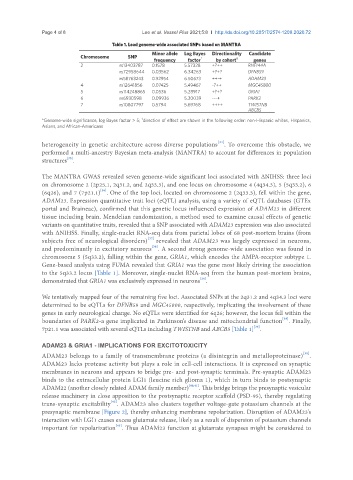
                                       Table 1. Lead genome-wide associated SNPs based on MANTRA
                                                    Minor allele   Log Bayes   Directionality   Candidate
                            Chromosome      SNP                      *           †
                                                     frequency  factor    by cohort    genes
                            2            rs13403787  0.1578    5.57328   +?++        RNF144A
                                         rs72958644  0.03562   6.34263   +?+?        DFNB59
                                         rs58763243  0.92954   6.50673   ++-+        ADAM23
                            4            rs12641856  0.07425   5.49467   -?++        MGC45800
                            5            rs114248865  0.0536   5.28917   +?+?        GRIA1
                            6            rs6930598  0.09936    5.30039   ---+        PARK2
                            7            rs10807797  0.5794    5.69768   ++++        TWISTNB
                                                                                     ABCB5

                                                 †
               *Genome-wide significance, log Bayes factor > 5;  direction of effect are shown in the following order: non-Hispanic whites, Hispanics,
               Asians, and African-Americans
                                                                          [34]
               heterogeneity in genetic architecture across diverse populations . To overcome this obstacle, we
               performed a multi-ancestry Bayesian meta-analysis (MANTRA) to account for differences in population
                        [35]
               structures .
               The MANTRA GWAS revealed seven genome-wide significant loci associated with ΔNIHSS: three loci
               on chromosome 2 (2p25.1, 2q31.2, and 2q33.3), and one locus on chromosome 4 (4q34.3), 5 (5q33.2), 6
                                   [36]
               (6q26), and 7 (7p21.1) . One of the top loci, located on chromosome 2 (2q33.3), fell within the gene,
               ADAM23. Expression quantitative trait loci (eQTL) analysis, using a variety of eQTL databases (GTEx
               portal and Braineac), confirmed that this genetic locus influenced expression of ADAM23 in different
               tissue including brain. Mendelian randomization, a method used to examine causal effects of genetic
               variants on quantitative traits, revealed that a SNP associated with ADAM23 expression was also associated
               with ΔNIHSS. Finally, single-nuclei RNA-seq data from parietal lobes of 68 post-mortem brains (from
                                                   [37]
               subjects free of neurological disorders)  revealed that ADAM23 was largely expressed in neurons,
                                                    [36]
               and predominantly in excitatory neurons . A second strong genome-wide association was found in
               chromosome 5 (5q33.2), falling within the gene, GRIA1, which encodes the AMPA-receptor subtype 1.
               Gene-based analysis using FUMA revealed that GRIA1 was the gene most likely driving the association
               to the 5q33.2 locus [Table 1]. Moreover, single-nuclei RNA-seq from the human post-mortem brains,
               demonstrated that GRIA1 was exclusively expressed in neurons .
                                                                     [36]
               We tentatively mapped four of the remaining five loci. Associated SNPs at the 2q31.2 and 4q34.3 loci were
               determined to be eQTLs for DFNB59 and MGC45800, respectively, implicating the involvement of these
               genes in early neurological change. No eQTLs were identified for 6q26; however, the locus fell within the
                                                                                                [38]
               boundaries of PARK2-a gene implicated in Parkinson’s disease and mitochondrial function . Finally,
                                                                                       [36]
               7p21.1 was associated with several eQTLs including TWISTNB and ABCB5 [Table 1] .

               ADAM23 & GRIA1 - IMPLICATIONS FOR EXCITOTOXICITY
               ADAM23 belongs to a family of transmembrane proteins (a disintegrin and metalloproteinase) .
                                                                                                       [39]
               ADAM23 lacks protease activity but plays a role in cell-cell interactions. It is expressed on synaptic
               membranes in neurons and appears to bridge pre- and post-synaptic terminals. Pre-synaptic ADAM23
               binds to the extracellular protein LGI1 (leucine rich glioma 1), which in turn binds to postsynaptic
               ADAM22 (another closely related ADAM family member) [40,41] . This bridge brings the presynaptic vesicular
               release machinery in close apposition to the postsynaptic receptor scaffold (PSD-95), thereby regulating
               trans-synaptic excitability . ADAM23 also clusters together voltage-gate potassium channels at the
                                      [42]
               presynaptic membrane [Figure 2], thereby enhancing membrane repolarization. Disruption of ADAM23’s
               interaction with LGI1 causes excess glutamate release, likely as a result of dispersion of potassium channels
                                        [43]
               important for repolarization . Thus ADAM23 function at glutamate synapses might be considered to

