


Page 48 - Read Online
P. 48
Page 8 of 12                Sciahbasi et al. Vessel Plus 2023;7:19  https://dx.doi.org/10.20517/2574-1209.2023.22


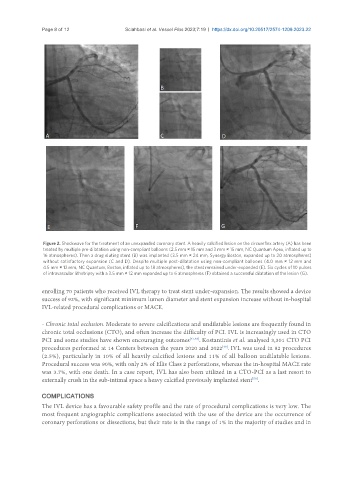
                Figure 2. Shockwave for the treatment of an unexpanded coronary stent. A heavily calcified lesion on the circumflex artery (A) has been
                treated by multiple pre-dilatation using non-compliant balloons (2.5 mm × 15 mm and 3 mm × 15 mm, NC Quantum Apex, inflated up to
                16 atmospheres). Then a drug eluting stent (B) was implanted (3.5 mm × 24 mm, Synergy Boston, expanded up to 20 atmospheres)
                without satisfactory expansion (C and D). Despite multiple post-dilatation using non-compliant balloons (4.0 mm × 12 mm and
                4.5 mm × 12 mm, NC Quantum, Boston, inflated up to 18 atmospheres), the stent remained under-expanded (E). Six cycles of 10 pulses
                of intravascular lithotripsy with a 3.5 mm × 12 mm expanded up to 6 atmospheres (F) obtained a successful dilatation of the lesion (G).

               enrolling 70 patients who received IVL therapy to treat stent under-expansion. The results showed a device
               success of 92%, with significant minimum lumen diameter and stent expansion increase without in-hospital
               IVL-related procedural complications or MACE.

               - Chronic total occlusion. Moderate to severe calcifications and undilatable lesions are frequently found in
               chronic total occlusions (CTO), and often increase the difficulty of PCI. IVL is increasingly used in CTO
               PCI and some studies have shown encouraging outcomes [47,48] . Kostantinis et al. analysed 3,301 CTO PCI
               procedures performed at 14 Centers between the years 2020 and 2022 . IVL was used in 82 procedures
                                                                            [49]
               (2.5%), particularly in 10% of all heavily calcified lesions and 11% of all balloon undilatable lesions.
               Procedural success was 90%, with only 2% of Ellis Class 2 perforations, whereas the in-hospital MACE rate
               was 3.7%, with one death. In a case report, IVL has also been utilized in a CTO-PCI as a last resort to
                                                                                      [50]
               externally crush in the sub-intimal space a heavy calcified previously implanted stent .

               COMPLICATIONS
               The IVL device has a favourable safety profile and the rate of procedural complications is very low. The
               most frequent angiographic complications associated with the use of the device are the occurrence of
               coronary perforations or dissections, but their rate is in the range of 1% in the majority of studies and in

