


Page 46 - Read Online
P. 46
Page 6 of 12                Sciahbasi et al. Vessel Plus 2023;7:19  https://dx.doi.org/10.20517/2574-1209.2023.22

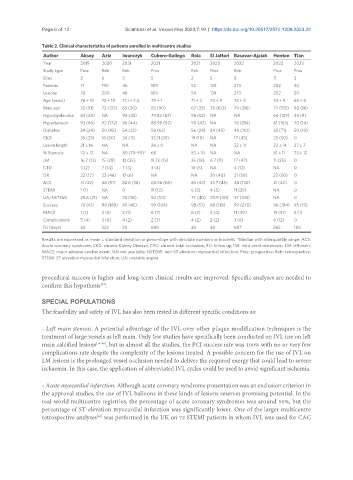
               Table 2. Clinical characteristics of patients enrolled in multicentre studies
                Author      Aksoy  Aziz   Iwanczyk  Cubero-Gallego  Rola  El Jattari Basavar-Ajaiah  Honton Tian
                Year        2019   2020   2021      2021         2021   2022    2022         2022   2023
                Study type  Pros   Retr   Retr      Pros         Retr   Pros    Retr         Pros   Pros
                Sites       3      6      3         5            2      5       8            11     3
                Patients    71     190    46        109          52     134     273          202    20
                Lesions     78     200    46        109          54     134     273          202    20
                Age (years)  76 ± 10  72 ± 10  71.1 ± 7.4  79 ± 1  71 ± 3  74 ± 9  72 ± 9    74 ± 9  65 ± 8
                Male sex    72 (51)  72 (137)  65 (30)  83 (90)  67 (35)  76 (102)  79 (216)  77 (155)  80 (16)
                Hyperlipidaemia   63 (45)  NA  94 (43)  79.82 (87)  96 (52)  NA  NA          64 (129)  45 (9)
                Hypertension  93 (66)  92 (172)  96 (44)  88.99 (97)  90 (47) NA  78 (214)   81 (163)  70 (14)
                Diabetes    34 (24)  50 (95)  54 (25)  58 (63)   56 (29)  34 (45)   40 (110)  35 (71)  50 (10)
                CKD         35 (25)  16 (30)  24 (11)  32.11 (35)  19 (10)  NA  17 (45)      25 (50)  0
                Lesion length  21 ± 16  NA  NA      26 ± 9       NA     NA      32 ± 11      22 ± 14  27 ± 7
                % Stenosis  72 ± 13  NA   80 (70-90)*  60        83 ± 10  NA    NA           81 ± 11  73 ± 12
                LM          16.7 (13)  15 (28)  12 (25)  11.72 (15)  35 (18)  6.7 (9)  17 (47)  11 (25)  0
                CTO         3 (2)  7 (14)  7 (3)    3 (4)        10 (5)  NA     4 (12)       NA     0
                ISR         22 (17)  23 (46)  17 (6)  NA         NA     30 (40)  21 (58)     23 (50)  0
                ACS         31 (22)  48 (91)  82.6 (38)  60.56 (66)  83 (43)  33.7 (45)  48 (132)  21 (42)  0
                STEMI       1 (1)  NA     0         11 (12)      6 (3)  4 (5)   11 (39)      NA     0
                UA/NSTEMI   29.6 (21) NA  78 (36)   50 (54)      77 (40) 29.9 (40)  37 (103)  NA    0
                Success     78 (61)  99 (189) 89 (45)  99 (108)  98 (51)  88 (118)  99 (270)  96 (194) 95 (19)
                MACE        1 (1)  3 (5)  2 (1)     6 (7)        6 (3)  3 (4)   11 (30)      15 (31)  5 (1)
                Complications  5 (4)  3 (6)  4 (2)  2 (3)        4 (2)  2 (2)   3 (8)        6 (12)  0
                FU (days)   30     222    30        600          30     30      687          365    180
               Results are expressed as mean ± standard deviation or percentage with absolute numbers in brackets. *Median with interquartile range; ACS:
               Acute coronary syndrome; CKD: chronic Kidney Disease; CTO: chronic total occlusion;; FU: follow up; ISR: intra-stent restenosis;  LM: left main;
               MACE: major adverse cardiac event; NA: not available; NSTEMI: non-ST elevation myocardial infarction; Pros: prospective; Retr: retrospective;
               STEMI: ST elevation myocardial infarction; UA: unstable angina.


               procedural success is higher and long-term clinical results are improved. Specific analyses are needed to
                                   [37]
               confirm this hypothesis .

               SPECIAL POPULATIONS
               The feasibility and safety of IVL has also been tested in different specific conditions as:

               - Left main stenosis. A potential advantage of the IVL over other plaque modification techniques is the
               treatment of large vessels as left main. Only few studies have specifically been conducted on IVL use on left
               main calcified lesions [38-40] , but in almost all the studies, the PCI success rate was 100% with no or very few
               complications rate despite the complexity of the lesions treated. A possible concern for the use of IVL on
               LM lesions is the prolonged vessel occlusion needed to deliver the required energy that could lead to severe
               ischaemia. In this case, the application of abbreviated IVL cycles could be used to avoid significant ischemia.

               - Acute myocardial infarction. Although acute coronary syndrome presentation was an exclusion criterion in
               the approval studies, the use of IVL balloons in these kinds of lesions reserves promising potential. In the
               real-world multicentre registries, the percentage of acute coronary syndromes was around 50%, but the
               percentage of ST-elevation myocardial infarction was significantly lower. One of the larger multicentre
               retrospective analyses  was performed in the UK on 72 STEMI patients in whom IVL was used for CAC
                                  [41]

