


Page 45 - Read Online
P. 45
Sciahbasi et al. Vessel Plus 2023;7:19  https://dx.doi.org/10.20517/2574-1209.2023.22  Page 5 of 12

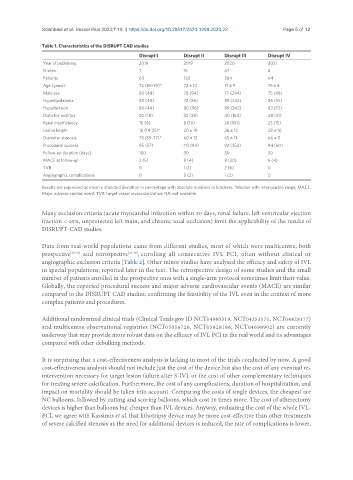
               Table 1. Characteristics of the DISRUPT CAD studies
                                                Disrupt I      Disrupt II    Disrupt III   Disrupt IV
                Year of publishing              2019           2019          2020          2021
                N sites                         7              15            47            8
                Patients                        60             120           384           64
                Age (years)                     72 (66-79)*    72 ± 10       71 ± 9        75 ± 8
                Male sex                        80 (48)        78 (94)       77 (294)      75 (48)
                Hyperlipidaemia                 80 (48)        72 (86)       89 (342)      86 (55)
                Hypertension                    80 (48)        80 (96)       89 (342)      83 (53)
                Diabetes mellitus               30 (18)        32 (38)       40 (154)      48 (31)
                Renal insufficiency             10 (6)         8 (10)        26 (101)      23 (15)
                Lesion length                   18 (14-25)*    20 ± 10       26 ± 12       28 ± 10
                Diameter stenosis               73 (59-77)*    60 ± 12       65 ± 11       66 ± 11
                Procedural success              95 (57)        113 (94)      92 (354)      94 (60)
                Follow-up duration (days)       180            30            30            30
                MACE at follow-up               2 (5)          8 (4)         8 (30)        6 (4)
                TVR                             0              1 (1)         2 (6)         0
                Angiographic complications      0              2 (2)         1 (2)         0

               Results are expressed as mean ± standard deviation or percentage with absolute numbers in brackets. *Median with interquartile range; MACE:
               Major adverse cardiac event; TVR: target vessel revascularization; NA: not available.


               Many exclusion criteria (acute myocardial infarction within 30 days, renal failure, left ventricular ejection
               fraction < 40%, unprotected left main, and chronic total occlusion) limit the applicability of the results of
               DISRUPT-CAD studies.


               Data from real-world populations came from different studies, most of which were multicentre, both
               prospective [28-32]   and  retrospective [33-36] , enrolling  all  consecutive  IVL  PCI,  often  without  clinical  or
               angiographic exclusion criteria [Table 2]. Other minor studies have analysed the efficacy and safety of IVL
               in special populations, reported later in the text. The retrospective design of some studies and the small
               number of patients enrolled in the prospective ones with a single-arm protocol sometimes limit their value.
               Globally, the reported procedural success and major adverse cardiovascular events (MACE) are similar
               compared to the DISRUPT CAD studies, confirming the feasibility of the IVL even in the context of more
               complex patients and procedures.

               Additional randomized clinical trials (Clinical Trials.gov ID NCT04960319, NCT04253171, NCT04428177)
               and multicentre observational registries (NCT05016726, NCT05828186, NCT04698902) are currently
               underway that may provide more robust data on the efficacy of IVL PCI in the real world and its advantages
               compared with other debulking methods.


               It is surprising that a cost-effectiveness analysis is lacking in most of the trials conducted by now. A good
               cost-effectiveness analysis should not include just the cost of the device but also the cost of any eventual re-
               intervention necessary for target lesion failure after S-IVL or the cost of other complementary techniques
               for treating severe calcification. Furthermore, the cost of any complications, duration of hospitalization, and
               impact on mortality should be taken into account. Comparing the costs of single devices, the cheapest are
               NC balloons, followed by cutting and scoring balloons, which cost 20 times more. The cost of atherectomy
               devices is higher than balloons but cheaper than IVL devices. Anyway, evaluating the cost of the whole IVL-
               PCI, we agree with Kassimis et al. that lithotripsy device may be more cost-effective than other treatments
               of severe calcified stenosis as the need for additional devices is reduced, the rate of complications is lower,

