


Page 25 - Read Online
P. 25
Andò et al. Vessel Plus 2023;7:15  https://dx.doi.org/10.20517/2574-1209.2023.26  Page 7 of 22

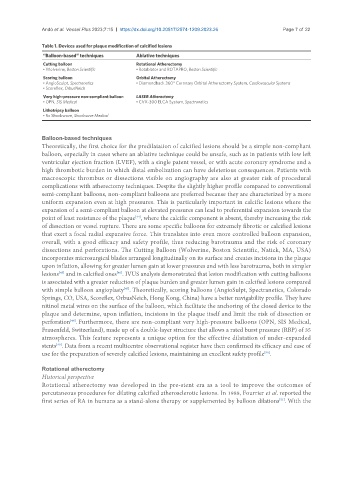
               Table 1. Devices used for plaque modification of calcified lesions
                “Balloon-based” techniques     Ablative techniques
                Cutting balloon                Rotational Atherectomy
                • Wolverine, Boston Scientific  • Rotablator and ROTAPRO, Boston Scientific
                Scoring balloon                Orbital Atherectomy
                • AngioSculpt, Spectranetics   • Diamondback 360° Coronary Orbital Atherectomy System, Cardiovascular Systems
                • Scoreflex, OrbusNeich
                Very high-pressure non-compliant balloon   LASER Atherectomy
                • OPN, SIS Medical             • CVX-300 ELCA System, Spectranetics
                Lithotripsy balloon
                • Rx Shockwave, Shockwave Medical


               Balloon-based techniques
               Theoretically, the first choice for the predilatation of calcified lesions should be a simple non-compliant
               balloon, especially in cases where an ablative technique could be unsafe, such as in patients with low left
               ventricular ejection fraction (LVEF), with a single patent vessel, or with acute coronary syndrome and a
               high thrombotic burden in which distal embolization can have deleterious consequences. Patients with
               macroscopic thrombus or dissections visible on angiography are also at greater risk of procedural
               complications with atherectomy techniques. Despite the slightly higher profile compared to conventional
               semi-compliant balloons, non-compliant balloons are preferred because they are characterized by a more
               uniform expansion even at high pressures. This is particularly important in calcific lesions where the
               expansion of a semi-compliant balloon at elevated pressures can lead to preferential expansion towards the
               point of least resistance of the plaque , where the calcific component is absent, thereby increasing the risk
                                               [44]
               of dissection or vessel rupture. There are some specific balloons for extremely fibrotic or calcified lesions
               that exert a focal radial expansive force. This translates into even more controlled balloon expansion,
               overall, with a good efficacy and safety profile, thus reducing barotrauma and the risk of coronary
               dissections and perforations. The Cutting Balloon (Wolverine, Boston Scientific, Natick, MA, USA)
               incorporates microsurgical blades arranged longitudinally on its surface and creates incisions in the plaque
               upon inflation, allowing for greater lumen gain at lower pressures and with less barotrauma, both in simpler
               lesions  and in calcified ones . IVUS analysis demonstrated that lesion modification with cutting balloons
                                        [46]
                     [45]
               is associated with a greater reduction of plaque burden and greater lumen gain in calcified lesions compared
               with simple balloon angioplasty . Theoretically, scoring balloons (AngioSulpt, Spectranetics, Colorado
                                           [47]
               Springs, CO, USA, Scoreflex, OrbusNeich, Hong Kong, China) have a better navigability profile. They have
               nitinol metal wires on the surface of the balloon, which facilitate the anchoring of the closed device to the
               plaque and determine, upon inflation, incisions in the plaque itself and limit the risk of dissection or
               perforation . Furthermore, there are non-compliant very high-pressure balloons (OPN, SIS Medical,
                         [48]
               Frauenfeld, Switzerland), made up of a double-layer structure that allows a rated burst pressure (RBP) of 35
               atmospheres. This feature represents a unique option for the effective dilatation of under-expanded
                    [49]
               stents . Data from a recent multicentre observational register have then confirmed its efficacy and ease of
               use for the preparation of severely calcified lesions, maintaining an excellent safety profile .
                                                                                          [50]
               Rotational atherectomy
               Historical perspective
               Rotational atherectomy was developed in the pre-stent era as a tool to improve the outcomes of
               percutaneous procedures for dilating calcified atherosclerotic lesions. In 1988, Fourrier et al. reported the
               first series of RA in humans as a stand-alone therapy or supplemented by balloon dilations . With the
                                                                                               [51]

