


Page 7 - Read Online
P. 7
Chen et al. Soft Sci. 2026, 6, 3                                                  Page 5 of 26


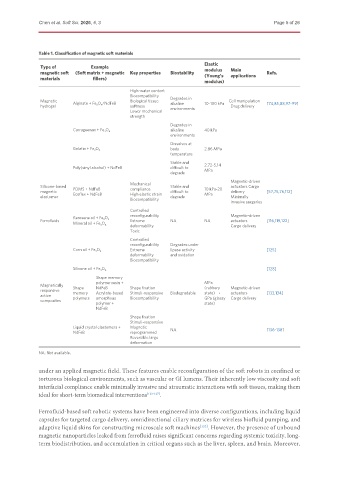
               Table 1. Classification of magnetic soft materials
                                                                         Elastic
               Type of           Example                                 modulus  Main
               magnetic soft  (Soft matrix + magnetic  Key properties  Biostability  (Young’s  applications  Refs.
               materials          fillers)
                                                                         modulus)
                                               High-water content
                                               Biocompatibility
               Magnetic    Alginate + Fe 3 O 4 /NdFeB  Biological tissue  Degrades in  Cell manipulation
               hydrogel                        softness      alkaline    10-100 kPa  Drug delivery  [74,85,88,97-99]
                                               Lower mechanical  environments
                                               strength
                                                             Degrades in
                                                             alkaline    40 kPa
                           Carrageenan + Fe 3 O 4
                                                             environments
                                                             Dissolves at
                                                             body        2.86 MPa
                           Gelatin + Fe 3 O 4
                                                             temperature
                                                             Stable and
                           Poly(vinyl alcohol) + NdFeB       difficult to  2.72-5.14
                                                             degrade     MPa
                                                                                  Magnetic-driven
                                               Mechanical
               Silicone-based                                Stable and           actuators Cargo
               magnetic    PDMS + NdFeB        compliance    difficult to  10 kPa-20  delivery  [57,75,76,112]
               elastomer   Ecoflex + NdFeB     High elastic strain  degrade  MPa  Minimally
                                               Biocompatibility
                                                                                  invasive surgeries
                                               Controlled
                                               reconfigurability                  Magnetic-driven
               Ferrofluids  Kerosene oil + Fe 3 O 4  Extreme  NA         NA       actuators    [116,119,122]
                                               deformability                      Cargo delivery
                           Mineral oil + Fe 3 O 4
                                               Toxic
                                               Controlled
                                               reconfigurability  Degrades under
                                               Extreme       lipase activity                   [125]
                           Corn oil + Fe 3 O 4
                                               deformability  and oxidation
                                               Biocompatibility
                                                                                               [128]
                           Silicone oil + Fe 3 O 4
                                   Shape memory
                                   polymer resin +                       MPa
               Magnetically  Shape  NdFeB      Shape fixation            (rubbery  Magnetic-driven
               responsive  memory  Acrylate-based  Stimuli-responsive  Biodegradable  state) →  actuators  [133,134]
               active      polymers  amorphous  Biocompatibility         GPa (glassy  Cargo delivery
               composites
                                   polymer +                             state)
                                   NdFeB
                                               Shape fixation
                                               Stimuli-responsive
                           Liquid crystal elastomers +  Magnetic
                           NdFeB               reprogrammed  NA                                [136-138]
                                               Reversible large
                                               deformation

               NA: Not available.

               under an applied magnetic field. These features enable reconfiguration of the soft robots in confined or
               torturous biological environments, such as vascular or GI lumens. Their inherently low viscosity and soft
               interfacial compliance enable minimally invasive and atraumatic interactions with soft tissues, making them
               ideal for short-term biomedical interventions [123-127] .

               Ferrofluid-based soft robotic systems have been engineered into diverse configurations, including liquid
               capsules for targeted cargo delivery, omnidirectional ciliary matrices for wireless biofluid pumping, and
               adaptive liquid skins for constructing microscale soft machines [123] . However, the presence of unbound
               magnetic nanoparticles leaked from ferrofluid raises significant concerns regarding systemic toxicity, long-
               term biodistribution, and accumulation in critical organs such as the liver, spleen, and brain. Moreover,

