


Page 3 - Read Online
P. 3
Mini Review | Open Access
Soft Science
Chen et al. Soft Sci. 2026, 6, 3 DOI:10.20517/ss.2025.97
Magnetic soft robots in medicine: material and
structural designs for organ-specific applications
Ziheng Chen , Shiqi Yang , Junhui Law , Xingzhou Du , Yu Sun 2,*
1,*
1,#
1,#
1,*
Keywords:
Magnetic soft robot,
minimally invasive
intervention, magnetic soft
materials, organ-specific
material and structural
design
Citation: Chen, Z.; Yang, S.;
Law, J.; Du, X.; Sun, Y.
Magnetic soft robots in
medicine: material and
structural designs for organ-
specific applications. Soft Sci.
2026, 6, 3. https://dx.doi.or
g/10.20517/ss.2025.97
Received: 30 Sep 2025
First Decision: 29 Oct Abstract
2025
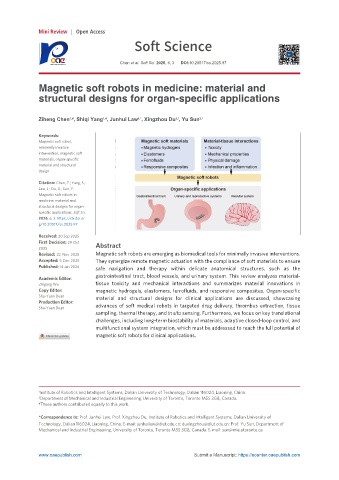
Revised: 22 Nov 2025 Magnetic soft robots are emerging as biomedical tools for minimally invasive interventions.
Accepted: 5 Dec 2025 They synergize remote magnetic actuation with the compliance of soft materials to ensure
Published: 14 Jan 2026 safe navigation and therapy within delicate anatomical structures, such as the
gastrointestinal tract, blood vessels, and urinary system. This review analyzes material-
Academic Editor:
Zhigang Wu tissue toxicity and mechanical interactions and summarizes material innovations in
Copy Editor: magnetic hydrogels, elastomers, ferrofluids, and responsive composites. Organ-specific
Shu-Yuan Duan material and structural designs for clinical applications are discussed, showcasing
Production Editor: advances of soft medical robots in targeted drug delivery, thrombus extraction, tissue
Shu-Yuan Duan
sampling, thermal therapy, and in situ sensing. Furthermore, we focus on key translational
challenges, including long-term biostability of materials, adaptive closed-loop control, and
multifunctional system integration, which must be addressed to reach the full potential of
magnetic soft robots for clinical applications.
1 Institute of Robotics and Intelligent Systems, Dalian University of Technology, Dalian 116024, Liaoning, China.
2 Department of Mechanical and Industrial Engineering, University of Toronto, Toronto M5S 3G8, Canada.
# These authors contributed equally to this work.
*Correspondence to: Prof. Junhui Law, Prof. Xingzhou Du, Institute of Robotics and Intelligent Systems, Dalian University of
Technology, Dalian 116024, Liaoning, China. E-mail: junhuilaw@dlut.edu.cn; duxingzhou@dlut.edu.cn; Prof. Yu Sun, Department of
Mechanical and Industrial Engineering, University of Toronto, Toronto M5S 3G8, Canada. E-mail: sun@mie.utoronto.ca
www.oaepublish.com Submit a Manuscript: https://ucenter.oaepublish.com

