


Page 33 - Read Online
P. 33
Page 4 of 33                                                          Ren et al. Soft Sci. 2026, 6, 6


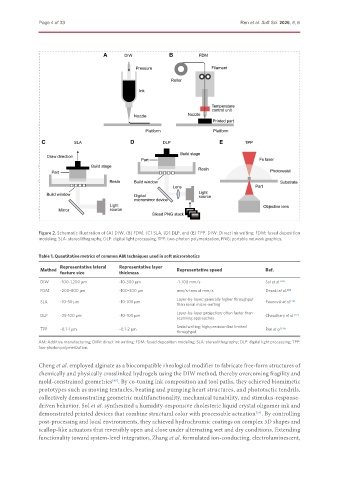
               Figure 2. Schematic illustration of (A) DIW, (B) FDM, (C) SLA, (D) DLP, and (E) TPP. DIW: Direct ink writing; FDM: fused deposition
               modeling; SLA: stereolithography; DLP: digital light processing; TPP: two-photon polymerization; PNG: portable network graphics.


               Table 1. Quantitative metrics of common AM techniques used in soft microrobotics
                      Representative lateral  Representative layer
               Method                                          Representative speed           Ref.
                      feature size         thickness
               DIW    ~100-1,200 μm        ~10-300 μm          ~1-100 mm/s                    Sol et al. [24]
               FDM    ~200-800 μm          ~100-300 μm         mm/s-tens of mm/s              Dezaki et al. [25]
                                                               Layer-by-layer; generally higher throughput
               SLA    ~10-50 μm            ~10-100 μm                                         Paunović et al. [26]
                                                               than serial micro-writing
                                                               Layer-by-layer projection; often faster than
               DLP    ~25-100 μm           ~10-100 μm                                         Chaudhary et al. [27]
                                                               scanning approaches
                                                               Serial writing; high precision but limited
               TPP    ~0.1-1 μm            ~0.1-2 μm                                          Ren et al. [28]
                                                               throughput
               AM: Additive manufacturing; DIW: direct ink writing; FDM: fused deposition modeling; SLA: stereolithography; DLP: digital light processing; TPP:
               two-photon polymerization.

               Cheng et al. employed alginate as a biocompatible rheological modifier to fabricate free-form structures of
               chemically and physically crosslinked hydrogels using the DIW method, thereby overcoming fragility and
               mold-constrained geometries . By co-tuning ink composition and tool paths, they achieved biomimetic
                                        [49]
               prototypes such as moving tentacles, beating and pumping heart structures, and phototactic tendrils,
               collectively demonstrating geometric multifunctionality, mechanical tunability, and stimulus-response-
               driven behavior. Sol et al. synthesized a humidity-responsive cholesteric liquid crystal oligomer ink and
               demonstrated printed devices that combine structural color with processable actuation . By controlling
                                                                                           [24]
               post-processing and local environments, they achieved hydrochromic coatings on complex 3D shapes and
               scallop-like actuators that reversibly open and close under alternating wet and dry conditions. Extending
               functionality toward system-level integration, Zhang et al. formulated ion-conducting, electroluminescent,

