


Page 30 - Read Online
P. 30
Review Article | Open Access
Soft Science
Ren et al. Soft Sci. 2026, 6, 6 DOI:10.20517/ss.2025.110
4D-printed soft microrobots: manufacturing,
materials, actuation and applications
Zhongguo Ren , Xinjian Fan , Hui Xie , Mengmeng Sun 2,4,*
3
1,*
1,2
Keywords:
4D printing, soft
microrobots, fabrication
strategies, intelligent
materials, stimuli,
applications
Citation: Ren, Z.; Fan, X.;
Xie, H.; Sun, M. 4D-printed
soft microrobots:
manufacturing, materials,
actuation and applications.
Soft Sci. 2026, 6, 6. https://
dx.doi.org/10.20517/ss.202
5.110
Received: 30 Oct 2025
First Decision: 11 Dec
2025 Abstract
Revised: 22 Dec 2025
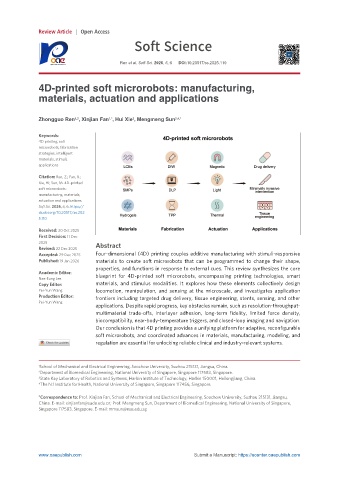
Accepted: 29 Dec 2025 Four-dimensional (4D) printing couples additive manufacturing with stimuli-responsive
Published: 19 Jan 2026 materials to create soft microrobots that can be programmed to change their shape,
properties, and functions in response to external cues. This review synthesizes the core
Academic Editor: blueprint for 4D-printed soft microrobots, encompassing printing technologies, smart
Nae-Eung Lee
Copy Editor: materials, and stimulus modalities. It explores how these elements collectively design
Pei-Yun Wang locomotion, manipulation, and sensing at the microscale, and investigates application
Production Editor: frontiers including targeted drug delivery, tissue engineering, stents, sensing, and other
Pei-Yun Wang
applications. Despite rapid progress, key obstacles remain, such as resolution-throughput-
multimaterial trade-offs, interlayer adhesion, long-term fidelity, limited force density,
biocompatibility, near-body-temperature triggers, and closed-loop imaging and navigation.
Our conclusion is that 4D printing provides a unifying platform for adaptive, reconfigurable
soft microrobots, and coordinated advances in materials, manufacturing, modeling, and
regulation are essential for unlocking reliable clinical and industry-relevant systems.
1 School of Mechanical and Electrical Engineering, Soochow University, Suzhou 215131, Jiangsu, China.
2 Department of Biomedical Engineering, National University of Singapore, Singapore 117583, Singapore.
3 State Key Laboratory of Robotics and Systems, Harbin Institute of Technology, Harbin 150001, Heilongjiang, China.
4 The N.1 Institute for Health, National University of Singapore, Singapore 117456, Singapore.
* Correspondence to: Prof. Xinjian Fan, School of Mechanical and Electrical Engineering, Soochow University, Suzhou 215131, Jiangsu,
China. E-mail: xinjianfan@suda.edu.cn; Prof. Mengmeng Sun, Department of Biomedical Engineering, National University of Singapore,
Singapore 117583, Singapore. E-mail: mmsun@nus.edu.sg
www.oaepublish.com Submit a Manuscript: https://ucenter.oaepublish.com

