


Page 32 - Read Online
P. 32
Ren et al. Soft Sci. 2026, 6, 6                                                   Page 3 of 33


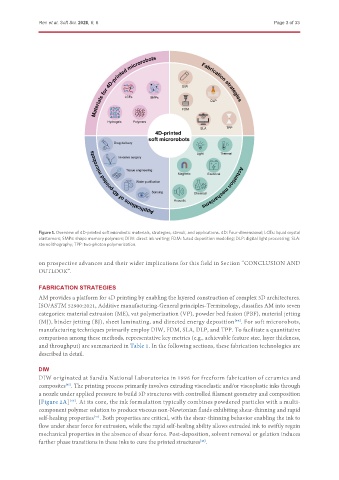
               Figure 1. Overview of 4D-printed soft microbots: materials, strategies, stimuli, and applications. 4D: Four-dimensional; LCEs: liquid crystal
               elastomers; SMPs: shape memory polymers; DIW: direct ink writing; FDM: fused deposition modeling; DLP: digital light processing; SLA:
               stereolithography; TPP: two-photon polymerization.


               on prospective advances and their wider implications for this field in Section “CONCLUSION AND
               OUTLOOK”.


               FABRICATION STRATEGIES
               AM provides a platform for 4D printing by enabling the layered construction of complex 3D architectures.
               ISO/ASTM 52900:2021, Additive manufacturing-General principles-Terminology, classifies AM into seven
               categories: material extrusion (ME), vat polymerization (VP), powder bed fusion (PBF), material jetting
               (MJ), binder jetting (BJ), sheet laminating, and directed energy deposition . For soft microrobots,
                                                                                   [44]
               manufacturing techniques primarily employ DIW, FDM, SLA, DLP, and TPP. To facilitate a quantitative
               comparison among these methods, representative key metrics (e.g., achievable feature size, layer thickness,
               and throughput) are summarized in Table 1. In the following sections, these fabrication technologies are
               described in detail.


               DIW
               DIW originated at Sandia National Laboratories in 1996 for freeform fabrication of ceramics and
               composites . The printing process primarily involves extruding viscoelastic and/or viscoplastic inks through
                        [45]
               a nozzle under applied pressure to build 3D structures with controlled filament geometry and composition
               [Figure 2A] . At its core, the ink formulation typically combines powdered particles with a multi-
                         [46]
               component polymer solution to produce viscous non-Newtonian fluids exhibiting shear-thinning and rapid
               self-healing properties . Both properties are critical, with the shear-thinning behavior enabling the ink to
                                  [47]
               flow under shear force for extrusion, while the rapid self-healing ability allows extruded ink to swiftly regain
               mechanical properties in the absence of shear force. Post-deposition, solvent removal or gelation induces
               further phase transitions in these inks to cure the printed structures .
                                                                       [48]

