


Page 37 - Read Online
P. 37
Page 8 of 33                                                          Ren et al. Soft Sci. 2026, 6, 6


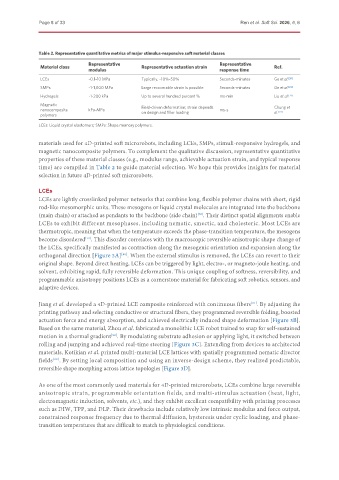
               Table 2. Representative quantitative metrics of major stimulus-responsive soft material classes
                                Representative                                Representative
               Material class                      Representative actuation strain               Ref.
                                modulus                                       response time
               LCEs             ~0.1-10 MPa        Typically, ~10%-50%        Seconds-minutes    Ge et al. [20]
               SMPs             ~1-1,000 MPa       Large recoverable strain is possible  Seconds-minutes  Ge et al. [22]
               Hydrogels        ~1-200 kPa         Up to several hundred percent %  ms-min       Liu et al. [77]
               Magnetic
               nanocomposite    kPa-MPa            Field-driven deformation; strain depends  ms-s  Chung et
                                                                                                   [23]
               polymers                            on design and filler loading                  al.
               LCEs: Liquid crystal elastomers; SMPs: Shape memory polymers.

               materials used for 4D-printed soft microrobots, including LCEs, SMPs, stimuli-responsive hydrogels, and
               magnetic nanocomposite polymers. To complement the qualitative discussion, representative quantitative
               properties of these material classes (e.g., modulus range, achievable actuation strain, and typical response
               time) are compiled in Table 2 to guide material selection. We hope this provides insights for material
               selection in future 4D-printed soft microrobots.


               LCEs
               LCEs are lightly crosslinked polymer networks that combine long, flexible polymer chains with short, rigid
               rod-like mesomorphic units. These mesogens or liquid crystal molecules are integrated into the backbone
               (main chain) or attached as pendants to the backbone (side chain) . Their distinct spatial alignments enable
                                                                      [78]
               LCEs to exhibit different mesophases, including nematic, smectic, and cholesteric. Most LCEs are
               thermotropic, meaning that when the temperature exceeds the phase-transition temperature, the mesogens
               become disordered . This disorder correlates with the macroscopic reversible anisotropic shape change of
                               [79]
               the LCEs, specifically manifested as contraction along the mesogenic orientation and expansion along the
               orthogonal direction [Figure 3A] . When the external stimulus is removed, the LCEs can revert to their
                                            [80]
               original shape. Beyond direct heating, LCEs can be triggered by light, electro-, or magneto-joule heating, and
               solvent, exhibiting rapid, fully reversible deformation. This unique coupling of softness, reversibility, and
               programmable anisotropy positions LCEs as a cornerstone material for fabricating soft robotics, sensors, and
               adaptive devices.


               Jiang et al. developed a 4D-printed LCE composite reinforced with continuous fibers . By adjusting the
                                                                                         [81]
               printing pathway and selecting conductive or structural fibers, they programmed reversible folding, boosted
               actuation force and energy absorption, and achieved electrically induced shape deformation [Figure 3B].
               Based on the same material, Zhou et al. fabricated a monolithic LCE robot trained to snap for self-sustained
               motion in a thermal gradient . By modulating substrate adhesion or applying light, it switched between
                                        [82]
               rolling and jumping and achieved real-time steering [Figure 3C]. Extending from devices to architected
               materials, Kotikian et al. printed multi-material LCE lattices with spatially programmed nematic director
               fields . By setting local composition and using an inverse-design scheme, they realized predictable,
                    [83]
               reversible shape morphing across lattice topologies [Figure 3D].

               As one of the most commonly used materials for 4D-printed microrobots, LCEs combine large reversible
               anisotropic strain, programmable orientation fields, and multi-stimulus actuation (heat, light,
               electromagnetic induction, solvents, etc.), and they exhibit excellent compatibility with printing processes
               such as DIW, TPP, and DLP. Their drawbacks include relatively low intrinsic modulus and force output,
               constrained response frequency due to thermal diffusion, hysteresis under cyclic loading, and phase-
               transition temperatures that are difficult to match to physiological conditions.

