


Page 16 - Read Online
P. 16
Chen et al. Soft Sci. 2026, 6, 3                                                 Page 13 of 26


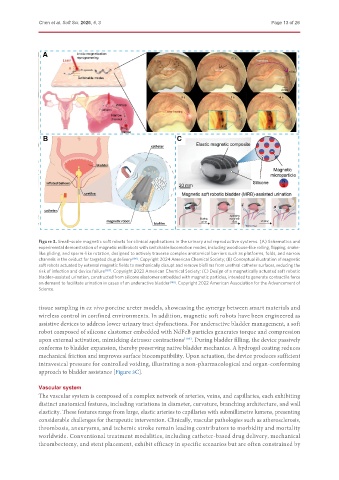
               Figure 3. Small-scale magnetic soft robots for clinical applications in the urinary and reproductive systems. (A) Schematics and
               experimental demonstration of magnetic millirobots with switchable locomotion modes, including woodlouse-like rolling, flipping, snake-
               like gliding, and sperm-like rotation, designed to actively traverse complex anatomical barriers such as platforms, folds, and narrow
               channels in the oviduct for targeted drug delivery [186] . Copyright 2024 American Chemical Society; (B) Conceptual illustration of magnetic
               soft robots actuated by external magnetic fields to mechanically disrupt and remove biofilms from urethral catheter surfaces, reducing the
               risk of infection and device failure [187] . Copyright 2023 American Chemical Society; (C) Design of a magnetically actuated soft robotic
               bladder-assisted urination, constructed from silicone elastomer embedded with magnetic particles, intended to generate contractile force
               on demand to facilitate urination in cases of an underactive bladder [189] . Copyright 2022 American Association for the Advancement of
               Science.

               tissue sampling in ex vivo porcine ureter models, showcasing the synergy between smart materials and
               wireless control in confined environments. In addition, magnetic soft robots have been engineered as
               assistive devices to address lower urinary tract dysfunctions. For underactive bladder management, a soft
               robot composed of silicone elastomer embedded with NdFeB particles generates torque and compression
               upon external activation, mimicking detrusor contractions [189] . During bladder filling, the device passively
               conforms to bladder expansion, thereby preserving native bladder mechanics. A hydrogel coating reduces
               mechanical friction and improves surface biocompatibility. Upon actuation, the device produces sufficient
               intravesical pressure for controlled voiding, illustrating a non-pharmacological and organ-conforming
               approach to bladder assistance [Figure 3C].


               Vascular system
               The vascular system is composed of a complex network of arteries, veins, and capillaries, each exhibiting
               distinct anatomical features, including variations in diameter, curvature, branching architecture, and wall
               elasticity. These features range from large, elastic arteries to capillaries with submillimetre lumens, presenting
               considerable challenges for therapeutic intervention. Clinically, vascular pathologies such as atherosclerosis,
               thrombosis, aneurysms, and ischemic stroke remain leading contributors to morbidity and mortality
               worldwide. Conventional treatment modalities, including catheter-based drug delivery, mechanical
               thrombectomy, and stent placement, exhibit efficacy in specific scenarios but are often constrained by

