


Page 18 - Read Online
P. 18
Chen et al. Soft Sci. 2026, 6, 3                                                 Page 15 of 26


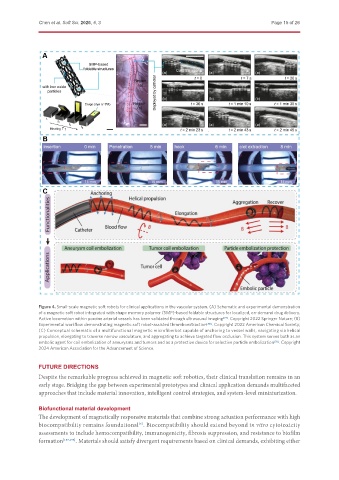
               Figure 4. Small-scale magnetic soft robots for clinical applications in the vascular system. (A) Schematic and experimental demonstration
               of a magnetic soft robot integrated with shape memory polymer (SMP)-based foldable structures for localized, on-demand drug delivery.
               Active locomotion within porcine arterial vessels has been validated through ultrasound imaging [77] . Copyright 2022 Springer Nature; (B)
               Experimental workflow demonstrating magnetic soft robot-assisted thromboextraction [191] . Copyright 2022 American Chemical Society;
               (C) Conceptual schematic of a multifunctional magnetic microfiberbot capable of anchoring to vessel walls, navigating via helical
               propulsion, elongating to traverse narrow vasculature, and aggregating to achieve targeted flow occlusion. This system serves both as an
               embolic agent for coil embolization of aneurysms and tumors and as a protective device for selective particle embolization [78] . Copyright
               2024 American Association for the Advancement of Science.


               FUTURE DIRECTIONS
               Despite the remarkable progress achieved in magnetic soft robotics, their clinical translation remains in an
               early stage. Bridging the gap between experimental prototypes and clinical application demands multifaceted
               approaches that include material innovation, intelligent control strategies, and system-level miniaturization.


               Biofunctional material development
               The development of magnetically responsive materials that combine strong actuation performance with high
               biocompatibility remains foundational . Biocompatibility should extend beyond in vitro cytotoxicity
                                                  [6]
               assessments to include hemocompatibility, immunogenicity, fibrosis suppression, and resistance to biofilm
               formation [157,198] . Materials should satisfy divergent requirements based on clinical demands, exhibiting either

