


Page 108 - Read Online
P. 108
Page 10 of 24                                                          Yu et al. Soft Sci. 2026, 6, 19


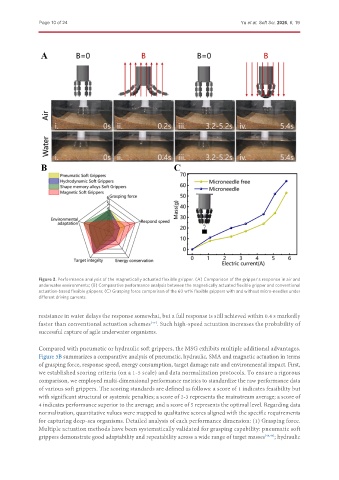
               Figure 3. Performance analysis of the magnetically actuated flexible gripper. (A) Comparison of the gripper’s response in air and
               underwater environments; (B) Comparative performance analysis between the magnetically actuated flexible gripper and conventional
               actuation-based flexible grippers; (C) Grasping force comparison of the 60 wt% flexible grippers with and without micro-needles under
               different driving currents.


               resistance in water delays the response somewhat, but a full response is still achieved within 0.4 s markedly
               faster than conventional actuation schemes . Such high-speed actuation increases the probability of
                                                      [47]
               successful capture of agile underwater organisms.

               Compared with pneumatic or hydraulic soft grippers, the MSG exhibits multiple additional advantages.
               Figure 3B summarizes a comparative analysis of pneumatic, hydraulic, SMA and magnetic actuation in terms
               of grasping force, response speed, energy consumption, target damage rate and environmental impact. First,
               we established scoring criteria (on a 1-5 scale) and data normalization protocols. To ensure a rigorous
               comparison, we employed multi-dimensional performance metrics to standardize the raw performance data
               of various soft grippers. The scoring standards are defined as follows: a score of 1 indicates feasibility but
               with significant structural or systemic penalties; a score of 2-3 represents the mainstream average; a score of
               4 indicates performance superior to the average; and a score of 5 represents the optimal level. Regarding data
               normalization, quantitative values were mapped to qualitative scores aligned with the specific requirements
               for capturing deep-sea organisms. Detailed analysis of each performance dimension: (1) Grasping force.
               Multiple actuation methods have been systematically validated for grasping capability: pneumatic soft
               grippers demonstrate good adaptability and repeatability across a wide range of target masses [48,49] ; hydraulic

