


Page 103 - Read Online
P. 103
Yu et al. Soft Sci. 2026, 6, 19                                                   Page 5 of 24


               digital multimeter, purchased online, manufactured by ITECH Electronics Co., Ltd.; magnetometer,
               purchased online, manufactured by ADEX Instruments Co., Ltd.; sealed high-pressure chamber,
               custom-fabricated, manufactured by Shenzhen Dinghai New Materials Technology Co., Ltd.


               All images were created using COMSOL, Solidworks, PowerPoint, Origin and Premiere Pro.


               RESULTS AND DISCUSSION
               Design rationale, application scenarios and actuation principle of the MSG
               Soft actuators, particularly soft grippers, have shown great promise for underwater inspection, biological
               sampling, and resource collection. Conventional rigid manipulators or soft grippers driven by tethered
               pneumatic/hydraulic systems commonly suffer from slow response, bulky hardware, the risk of damaging
               delicate targets, and potential leakage/pollution in complex subsea environments. Magnetic soft grippers
               offer an effective alternative to these approaches due to their non-contact actuation, rapid response,
               structural simplicity, and environmental compatibility. Focusing on operation in complex underwater
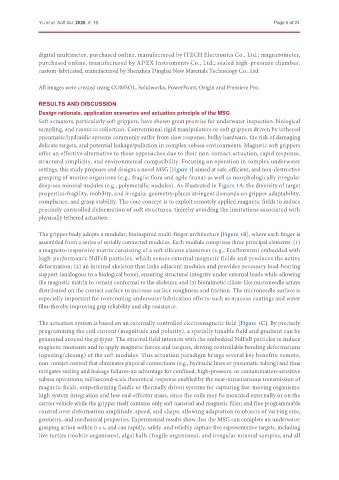
               settings, this study proposes and designs a novel MSG [Figure 1] aimed at safe, efficient, and non-destructive
               grasping of marine organisms (e.g., fragile flora and agile fauna) as well as morphologically irregular
               deep-sea mineral nodules (e.g., polymetallic nodules). As illustrated in Figure 1A, the diversity of target
               properties-fragility, mobility, and irregular geometry-places stringent demands on gripper adaptability,
               compliance, and grasp stability. The core concept is to exploit remotely applied magnetic fields to induce
               precisely controlled deformation of soft structures, thereby avoiding the limitations associated with
               physically tethered actuation.

               The gripper body adopts a modular, bioinspired multi-finger architecture [Figure 1B], where each finger is
               assembled from a series of serially connected modules. Each module comprises three principal elements: (1)
               a magneto-responsive matrix consisting of a soft silicone elastomer (e.g., Ecoflex0020) embedded with
               high-performance NdFeB particles, which senses external magnetic fields and produces the active
               deformation; (2) an internal skeleton that links adjacent modules and provides necessary load-bearing
               support (analogous to a biological bone), ensuring structural integrity under external loads while allowing
               the magnetic matrix to remain conformal to the skeleton; and (3) biomimetic ciliate-like microneedle arrays
               distributed on the contact surface to increase surface roughness and friction. The microneedle surface is
               especially important for overcoming underwater lubrication effects-such as mucous coatings and water
               film-thereby improving grip reliability and slip resistance.


               The actuation system is based on an externally controlled electromagnetic field [Figure 1C]. By precisely
               programming the coil current (magnitude and polarity), a spatially tunable field and gradient can be
               generated around the gripper. The external field interacts with the embedded NdFeB particles to induce
               magnetic moments and to apply magnetic forces and torques, driving controllable bending deformations
               (opening/closing) of the soft modules. This actuation paradigm brings several key benefits: remote,
               non-contact control that eliminates physical connections (e.g., hydraulic lines or pneumatic tubing) and thus
               mitigates sealing and leakage failures-an advantage for confined, high-pressure, or contamination-sensitive
               subsea operations; millisecond-scale theoretical response enabled by the near-instantaneous transmission of
               magnetic fields, outperforming fluidic or thermally driven systems for capturing fast-moving organisms;
               high system integration and low end-effector mass, since the coils may be mounted externally or on the
               carrier vehicle while the gripper itself contains only soft material and magnetic filler; and fine programmable
               control over deformation amplitude, speed, and shape, allowing adaptation to objects of varying size,
               geometry, and mechanical properties. Experimental results show that the MSG can complete an underwater
               grasping action within 0.4 s, and can rapidly, safely, and reliably capture five representative targets, including
               live turtles (mobile organisms), algal balls (fragile organisms), and irregular mineral samples, and all

