


Page 106 - Read Online
P. 106
Page 8 of 24                                                           Yu et al. Soft Sci. 2026, 6, 19


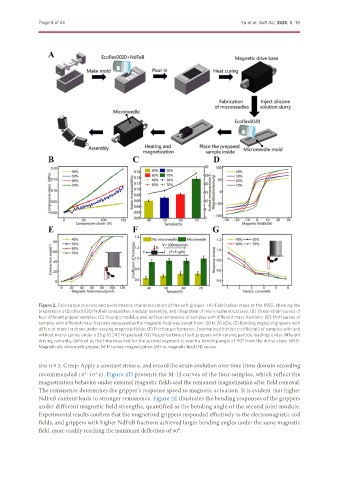
               Figure 2. Fabrication process and performance characterization of the soft gripper. (A) Fabrication steps of the MSG, showing the
               preparation of Ecoflex0020/NdFeB composites, modular assembly, and integration of micro-spine structures; (B) Stress-strain curves of
               four different gripper samples; (C) Young’s modulus and surface remanence of samples with different mass fractions; (D) M-H curves of
               samples with different mass fractions measured as the magnetic field was swept from -30 to 30 kOe; (E) Bending angles of grippers with
               different mass fractions under varying magnetic fields; (F) Friction performance (normalized friction coefficient) of samples with and
               without micro-spines under a 35 g (0.343 N) preload; (G) Response time of soft grippers with varying particle loadings under different
               driving currents, defined as the time required for the second segment to reach a bending angle of 90° from the initial state. MSG:
               Magnetically driven soft gripper; M-H curves: magnetization (M) vs. magnetic field (H) curves.


               size n ≥ 3. Creep: Apply a constant stress σ 0 and record the strain evolution over time (time domain recording
               recommended 10 -10  s). Figure 2D presents the M-H curves of the four samples, which reflect the
                                   4
                               2
               magnetization behavior under external magnetic fields and the remanent magnetization after field removal.
               The remanence determines the gripper’s response speed to magnetic actuation. It is evident that higher
               NdFeB content leads to stronger remanence. Figure 2E illustrates the bending responses of the grippers
               under different magnetic field strengths, quantified as the bending angle of the second joint module.
               Experimental results confirm that the magnetized grippers responded effectively to the electromagnetic coil
               fields, and grippers with higher NdFeB fractions achieved larger bending angles under the same magnetic
               field, more readily reaching the maximum deflection of 90°.

