


Page 112 - Read Online
P. 112
Page 14 of 24                                                          Yu et al. Soft Sci. 2026, 6, 19


               and an underwater camera could be equipped to the MSG for precise underwater detection and grasping,
               making the MSG more intelligent and promising for future deep-sea applications.

               In summary, the above performance evaluations demonstrate that the MSG affords clear benefits in response
               speed, environmental adaptability and safe handling relative to existing underwater grippers. To further
               elucidate the magneto-fluid-structure coupling mechanisms underlying these behaviors, we next perform
               detailed simulations of the MSG’s underwater motion under varied current magnitudes and polarities, to
               quantify magnetic-field distributions during deformation, gripper displacements, and induced fluid motion.
               These analyses will provide theoretical guidance for multi-objective optimization of future MSGs.


               Magnetic field simulation and fluid motion during the MSG’s grasping process
               Based on the preceding material characterization, the optimal NdFeB to Ecoflex0020 mass ratio was
               determined to be 60 wt%. Using this composition, the soft gripper was fabricated and assembled, and its
               electromagnetic actuation response and grasping capacity were experimentally evaluated. To assess grasping
               feasibility and to characterize the gripper’s interaction with the surrounding flow under submerged
               conditions, we performed a set of preliminary grasping tests and multiphysics simulations.


               A preliminary grasping experiment was carried out in air to validate the basic manipulation capability
               [Figure 4A and Supplementary Movie 3]. A cylindrical target with a mass of 15 g was used. Upon
               energization, the gripper expanded rapidly within 0.2 s and maintained the open configuration for 3 s. The
               current polarity was then reversed and, under the action of the magnetic torque, the gripper contracted to
               enclose the object. After holding the grasp for 2 s, the power was cut and the gripper returned to its relaxed
               initial state. The temporal profile of the opening-closing motion agreed closely with prior response
               measurements and numerical predictions, confirming the practical feasibility of the proposed magnetic
               actuation scheme and providing a baseline for subsequent in-water testing.


               To investigate underwater dynamics and flow interaction, a magneto-fluid-structure interaction (MFSI)
               model was established. The simulation was implemented using COMSOL. The model includes three physical
               fields: magnetic field, solid mechanics, and laminar flow, and incorporates multi-physics coupling modules
               such as dynamic mesh, magneto-mechanics, and fluid-structure interaction. The constitutive model for the
               material is an Ecoflex0020/NdFeB composite flexible material; therefore, the elastic matrix adopts the
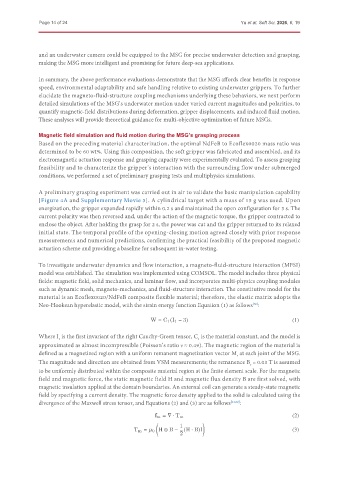
               Neo-Hookean hyperelastic model, with the strain energy function Equation (1) as follows :
                                                                                          [60]

                                                      W = C 1 (I 1 − 3)                                 (1)

               Where I  is the first invariant of the right Cauchy-Green tensor, C  is the material constant, and the model is
                      1
                                                                       1
               approximated as almost incompressible (Poisson’s ratio ν ≈ 0.49). The magnetic region of the material is
               defined as a magnetized region with a uniform remanent magnetization vector M  at each joint of the MSG.
                                                                                    r
               The magnitude and direction are obtained from VSM measurements; the remanence B  = 0.03 T is assumed
                                                                                         r
               to be uniformly distributed within the composite material region at the finite element scale. For the magnetic
               field and magnetic force, the static magnetic field H and magnetic flux density B are first solved, with
               magnetic insulation applied at the domain boundaries. An external coil can generate a steady-state magnetic
               field by specifying a current density. The magnetic force density applied to the solid is calculated using the
               divergence of the Maxwell stress tensor, and Equations (2) and (3) are as follows [61,62] :

                                                                                                        (2)
                                                       f m = ∇ · T m
                                                        (               )
                                                                1
                                                T m =    0 H ⊗ B −  (H · B)I                            (3)
                                                                2

