


Page 19 - Read Online
P. 19
Fan et al. Soft Sci 2024;4:43  https://dx.doi.org/10.20517/ss.2024.63            Page 3 of 10


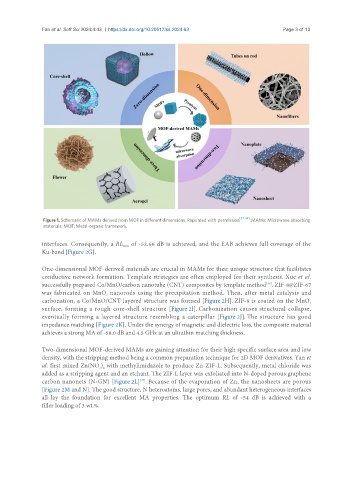
                Figure 1. Schematic of MAMs derived from MOF in different dimensions. Reprinted with permission [37-44] . MAMs: Microwave absorbing
                materials; MOF: Metal-organic framework.

               interfaces. Consequently, a RL  of -52.66 dB is achieved, and the EAB achieves full coverage of the
                                           min
               Ku-band [Figure 2G].


               One-dimensional MOF-derived materials are crucial in MAMs for their unique structure that facilitates
               conductive network formation. Template strategies are often employed for their synthesis. Xue et al.
               successfully prepared Co/MnO/carbon nanotube (CNT) composites by template method . ZIF-8@ZIF-67
                                                                                           [46]
               was fabricated on MnO  nanorods using the precipitation method. Then, after metal catalysis and
                                     2
               carbonation, a Co/MnO/CNT layered structure was formed [Figure 2H]. ZIF-8 is coated on the MnO 2
               surface, forming a rough core-shell structure [Figure 2I]. Carbonization causes structural collapse,
               eventually forming a layered structure resembling a caterpillar [Figure 2J]. The structure has good
               impedance matching [Figure 2K]. Under the synergy of magnetic and dielectric loss, the composite material
               achieves a strong MA of -58.0 dB and 4.5 GHz at an ultrathin matching thickness.


               Two-dimensional MOF-derived MAMs are gaining attention for their high specific surface area and low
               density, with the stripping method being a common preparation technique for 2D MOF derivatives. Yan et
               al. first mixed Zn(NO )  with methylimidazole to produce Zn-ZIF-L. Subsequently, metal chloride was
                                  3 2
               added as a stripping agent and an etchant. The ZIF-L layer was exfoliated into N-doped porous graphene
                                                [47]
               carbon nanonets (N-GN) [Figure 2L] . Because of the evaporation of Zn, the nanosheets are porous
               [Figure 2M and N]. The good structure, N heteroatoms, large pores, and abundant heterogeneous interfaces
               all  lay  the  foundation  for  excellent  MA  properties.  The  optimum  RL  of  -54  dB  is  achieved  with  a
               filler loading of 3 wt.%.

