


Page 81 - Read Online
P. 81
Duan et al. Soft Sci. 2025, 5, 4  https://dx.doi.org/10.20517/ss.2024.46         Page 3 of 15


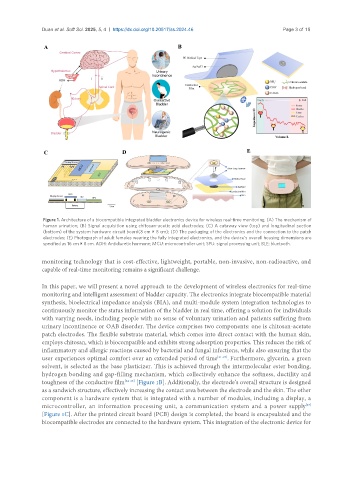
                Figure 1. Architecture of a biocompatible integrated bladder electronics device for wireless real-time monitoring. (A) The mechanism of
                human urination; (B) Signal acquisition using chitosan-acetic acid electrodes; (C) A cutaway view (top) and longitudinal section
                (bottom) of the system hardware circuit board(8 cm × 8 cm); (D) The packaging of the electronics and the connection to the patch
                electrodes; (E) Photograph of adult females wearing the fully integrated electronics, and the device’s overall housing dimensions are
                specified as 16 cm × 8 cm. ADH: Antidiuretic hormone; MCU: microcontroller unit; SPU: signal processing unit; BLE: bluetooth.

               monitoring technology that is cost-effective, lightweight, portable, non-invasive, non-radioactive, and
               capable of real-time monitoring remains a significant challenge.


               In this paper, we will present a novel approach to the development of wireless electronics for real-time
               monitoring and intelligent assessment of bladder capacity. The electronics integrate biocompatible material
               synthesis, bioelectrical impedance analysis (BIA), and multi-module system integration technologies to
               continuously monitor the status information of the bladder in real time, offering a solution for individuals
               with varying needs, including people with no sense of voluntary urination and patients suffering from
               urinary incontinence or OAB disorder. The device comprises two components: one is chitosan-acetate
               patch electrodes. The flexible substrate material, which comes into direct contact with the human skin,
               employs chitosan, which is biocompatible and exhibits strong adsorption properties. This reduces the risk of
               inflammatory and allergic reactions caused by bacterial and fungal infections, while also ensuring that the
               user experiences optimal comfort over an extended period of time [21-23] . Furthermore, glycerin, a green
               solvent, is selected as the base plasticizer. This is achieved through the intermolecular ester bonding,
               hydrogen bonding and gap-filling mechanism, which collectively enhance the softness, ductility and
               toughness of the conductive film [24-26]  [Figure 1B]. Additionally, the electrode’s overall structure is designed
               as a sandwich structure, effectively increasing the contact area between the electrode and the skin. The other
               component is a hardware system that is integrated with a number of modules, including a display, a
               microcontroller, an information processing unit, a communication system and a power supply
                                                                                                        [27]
               [Figure 1C]. After the printed circuit board (PCB) design is completed, the board is encapsulated and the
               biocompatible electrodes are connected to the hardware system. This integration of the electronic device for

