


Page 34 - Read Online
P. 34
Zhang et al. Soft Sci 2024;4:39  https://dx.doi.org/10.20517/ss.2024.34          Page 5 of 28


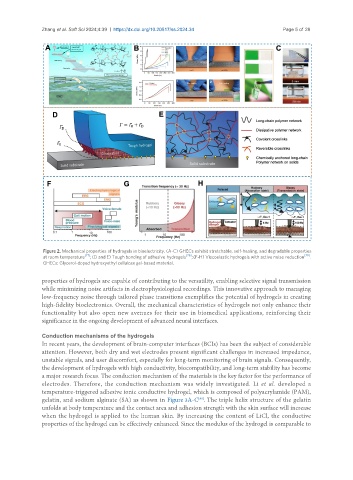
                Figure 2. Mechanical properties of hydrogels in bioelectricity. (A-C) GHECs exhibit stretchable, self-healing, and degradable properties
                at room temperature [77] ; (D and E) Tough bonding of adhesive hydrogels [78] ; (F-H) Viscoelastic hydrogels with active noise reduction [79] .
                GHECs: Glycerol-doped hydroxyethyl cellulose gel-based material.

               properties of hydrogels are capable of contributing to the versatility, enabling selective signal transmission
               while minimizing noise artifacts in electrophysiological recordings. This innovative approach to managing
               low-frequency noise through tailored phase transitions exemplifies the potential of hydrogels in creating
               high-fidelity bioelectronics. Overall, the mechanical characteristics of hydrogels not only enhance their
               functionality but also open new avenues for their use in biomedical applications, reinforcing their
               significance in the ongoing development of advanced neural interfaces.

               Conduction mechanisms of the hydrogels
               In recent years, the development of brain-computer interfaces (BCIs) has been the subject of considerable
               attention. However, both dry and wet electrodes present significant challenges in increased impedance,
               unstable signals, and user discomfort, especially for long-term monitoring of brain signals. Consequently,
               the development of hydrogels with high conductivity, biocompatibility, and long-term stability has become
               a major research focus. The conduction mechanism of the materials is the key factor for the performance of
               electrodes. Therefore, the conduction mechanism was widely investigated. Li et al. developed a
               temperature-triggered adhesive ionic conductive hydrogel, which is composed of polyacrylamide (PAM),
               gelatin, and sodium alginate (SA) as shown in Figure 3A-C . The triple helix structure of the gelatin
                                                                    [80]
               unfolds at body temperature and the contact area and adhesion strength with the skin surface will increase
               when the hydrogel is applied to the human skin. By increasing the content of LiCl, the conductive
               properties of the hydrogel can be effectively enhanced. Since the modulus of the hydrogel is comparable to

