


Page 22 - Read Online
P. 22
Page 20 of 27                             He et al. Soft Sci 2024;4:37  https://dx.doi.org/10.20517/ss.2024.32


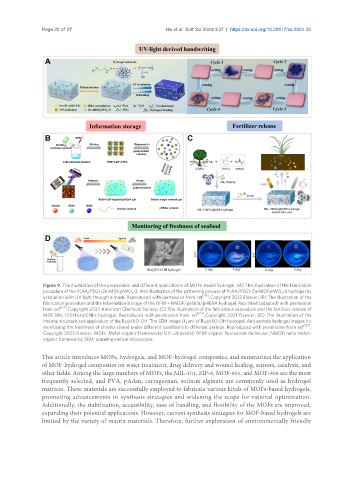
                Figure 9. The illustration of the preparation and different applications of MOFs-based hydrogel. (A) The illustration of the fabrication
                procedure of the P(AA/PEG)-Zn-MOF@WO -3. And illustration of the patterning process of P(AA/PEG)-Zn-MOF@WO -3 hydrogel by
                                             3
                                                                                                3
                irradiation with UV light through a mask. Reproduced with permission from  ref [119] . Copyright 2023 Elsever; (B) The illustration of the
                fabrication procedure and the information storage of the OFM + NMOF/gelatin/pHEAA hydrogel. Reprinted (adapted) with permission
                from  ref [122] . Copyright 2022 American Chemical Society; (C) The illustration of the fabrication procedure and the fertilizer release of
                MOF MIL-100(Fe)@CNFs hydrogel. Reproduced with permission from  ref [124] . Copyright 2021 Elsevier; (D) The illustration of the
                internal structure and application of the Ru@UiO-OH. The SEM image (1 μm) of Ru@UiO-OH hydrogel. And sensory hydrogel images for
                monitoring the freshness of shrimp stored under different conditions in different periods. Reproduced with permission from  ref [127] .
                Copyright 2023 Elsevier. MOFs: Metal-organic frameworks; UV: ultraviolet; OFM: organic fluorescent molecular; NMOF: nano metal−
                organic frameworks; SEM: scanning eletron microscope.

               This article introduces MOFs, hydrogels, and MOF-hydrogel composites, and summarizes the application
               of MOF-hydrogel composites on water treatment, drug delivery and wound healing, sensors, catalysts, and
               other fields. Among the large numbers of MOFs, the MIL-101, ZIF-8, MOF-801, and MOF-808 are the most
               frequently selected, and PVA, pAAm, carrageenan, sodium alginate are commonly used as hydrogel
               matrices. These materials are successfully employed to fabricate various kinds of MOFs-based hydrogels,
               promoting advancements in synthesis strategies and widening the scope for rational optimization.
               Additionally, the stabilization, accessibility, ease of handling, and flexibility of the MOFs are improved,
               expanding their potential applications. However, current synthesis strategies for MOF-based hydrogels are
               limited by the variety of matrix materials. Therefore, further exploration of environmentally friendly

