


Page 49 - Read Online
P. 49
Research Article | Open Access
Soft Science
Zhao et al. Soft Sci. 2026, 6, 4 DOI:10.20517/ss.2025.93
Machine learning-enabled on-mask triboelectric
textile electronic system for real-time respiratory
dynamics monitoring
Jia Zhao 1,2,# , Xiaosen Pan 1,2,# , Ming Yuan , Yunxiang Long 1,2,3 , Yi Niu , Yuyang Sun 1,2,4 , Jun Wang , Ting
5
1,2
1,2
Lin , Junjie Gan , Feng Xu 1,2,* , Yunsheng Fang 1,2,*
6
4
Keywords:
Triboelectric sensors, textile
electronics, plasma
treatment, respiratory
monitoring, machine
learning
Citation: Zhao, J.; Pan, X.;
Yuan, M.; Long, Y.; Niu, Y.;
Sun, Y.; Wang, J.; Lin, T.;
Gan, J.; Xu, F.; Fang, Y.
Machine learning-enabled
on-mask triboelectric textile
electronic system for
real-time respiratory
dynamics monitoring. Soft
Sci. 2026, 6, 4. https://dx.d
oi.org/10.20517/ss.2025.93
Abstract
Received: 22 Sep 2025
First Decision: 14 Oct Real-time and accurate respiratory monitoring is crucial in extreme conditions, such as
2025 high-altitude aviation, critical care, and hazardous occupations, where subtle respiratory
Revised: 4 Nov 2025 changes may rapidly escalate into life-threatening events. However, existing respiratory
Accepted: 19 Nov 2025 support systems are often cumbersome, insensitive to nuanced breathing patterns, or
Published: 16 Jan 2026
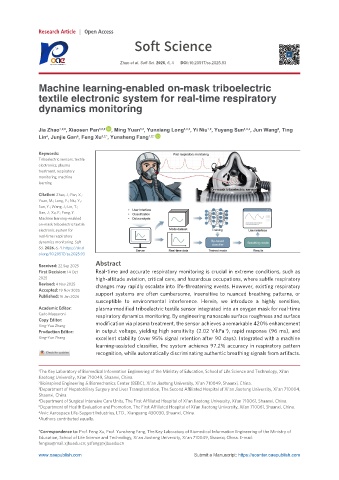
susceptible to environmental interference. Herein, we introduce a highly sensitive,
Academic Editor: plasma-modified triboelectric textile sensor integrated into an oxygen mask for real-time
Carlo Massaroni respiratory dynamics monitoring. By engineering nanoscale surface roughness and surface
Copy Editor: modification via plasma treatment, the sensor achieves a remarkable 420% enhancement
Xing-Yue Zhang
-1
Production Editor: in output voltage, yielding high sensitivity (2.02 V·kPa ), rapid response (96 ms), and
Xing-Yue Zhang excellent stability (over 95% signal retention after 90 days). Integrated with a machine
learning-assisted classifier, the system achieves 97.2% accuracy in respiratory pattern
recognition, while automatically discriminating authentic breathing signals from artifacts.
1 The Key Laboratory of Biomedical Information Engineering of the Ministry of Education, School of Life Science and Technology, Xi’an
Jiaotong University, Xi’an 710049, Shaanxi, China.
2 Bioinspired Engineering & Biomechanics Center (BEBC), Xi’an Jiaotong University, Xi’an 710049, Shaanxi, China.
3 Department of Hepatobiliary Surgery and Liver Transplantation, The Second Affiliated Hospital of Xi’an Jiaotong University, Xi’an 710004,
Shaanxi, China.
4 Department of Surgical Intensive Care Units, The First Affiliated Hospital of Xi’an Jiaotong University, Xi’an 710061, Shaanxi, China.
5 Department of Health Evaluation and Promotion, The First Affiliated Hospital of Xi’an Jiaotong University, Xi’an 710061, Shaanxi, China.
6 Avic Aerospace Life-Support Industries, LTD., Xiangyang 430030, Shaanxi, China.
# Authors contributed equally.
* Correspondence to: Prof. Feng Xu, Prof. Yunsheng Fang, The Key Laboratory of Biomedical Information Engineering of the Ministry of
Education, School of Life Science and Technology, Xi’an Jiaotong University, Xi’an 710049, Shaanxi, China. E-mail:
fengxu@mail.xjtu.edu.cn; ysfang@xjtu.edu.cn
www.oaepublish.com Submit a Manuscript: https://ucenter.oaepublish.com

