


Page 44 - Read Online
P. 44
Li et al. Soft Sci. 2025, 5, 13  https://dx.doi.org/10.20517/ss.2024.60          Page 7 of 11


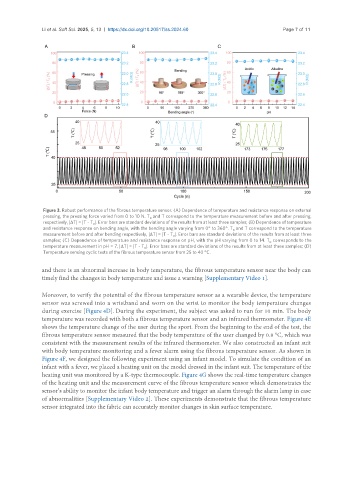
                Figure 3. Robust performance of the fibrous temperature sensor. (A) Dependence of temperature and resistance response on external
                pressing, the pressing force varied from 0 to 10 N. T  and T correspond to the temperature measurement before and after pressing,
                                                    0
                respectively, |ΔT| = |T - T |. Error bars are standard deviations of the results from at least three samples; (B) Dependence of temperature
                                0
                and resistance response on bending angle, with the bending angle varying from 0° to 360°. T  and T correspond to the temperature
                                                                                0
                measurement before and after bending respectively, |ΔT| = |T - T |. Error bars are standard deviations of the results from at least three
                                                           0
                samples; (C) Dependence of temperature and resistance response on pH, with the pH varying from 0 to 14. T  corresponds to the
                                                                                            0
                temperature measurement in pH = 7, |ΔT| = |T - T |. Error bars are standard deviations of the results from at least three samples; (D)
                                                  0
                Temperature sensing cyclic tests of the fibrous temperature sensor from 25 to 40 °C.
               and there is an abnormal increase in body temperature, the fibrous temperature sensor near the body can
               timely find the changes in body temperature and issue a warning [Supplementary Video 1].
               Moreover, to verify the potential of the fibrous temperature sensor as a wearable device, the temperature
               sensor was screwed into a wristband and worn on the wrist to monitor the body temperature changes
               during exercise [Figure 4D]. During the experiment, the subject was asked to run for 10 min. The body
               temperature was recorded with both a fibrous temperature sensor and an infrared thermometer. Figure 4E
               shows the temperature change of the user during the sport. From the beginning to the end of the test, the
               fibrous temperature sensor measured that the body temperature of the user changed by 0.8 °C, which was
               consistent with the measurement results of the infrared thermometer. We also constructed an infant suit
               with body temperature monitoring and a fever alarm using the fibrous temperature sensor. As shown in
               Figure 4F, we designed the following experiment using an infant model. To simulate the condition of an
               infant with a fever, we placed a heating unit on the model dressed in the infant suit. The temperature of the
               heating unit was monitored by a K-type thermocouple. Figure 4G shows the real-time temperature changes
               of the heating unit and the measurement curve of the fibrous temperature sensor which demonstrates the
               sensor’s ability to monitor the infant body temperature and trigger an alarm through the alarm lamp in case
               of abnormalities [Supplementary Video 2]. These experiments demonstrate that the fibrous temperature
               sensor integrated into the fabric can accurately monitor changes in skin surface temperature.

