


Page 43 - Read Online
P. 43
Page 6 of 11                             Li et al. Soft Sci. 2025, 5, 13  https://dx.doi.org/10.20517/ss.2024.60


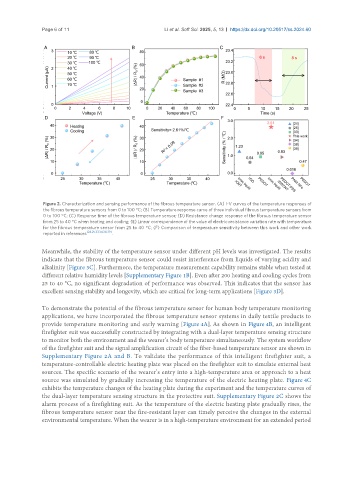
                Figure 2. Characterization and sensing performance of the fibrous temperature sensor. (A) I-V curves of the temperature responses of
                the fibrous temperature sensors from 0 to 100 °C; (B) Temperature response curve of three individual fibrous temperature sensors from
                0 to 100 °C; (C) Response time of the fibrous temperature sensor; (D) Resistance change response of the fibrous temperature sensor
                from 25 to 40 °C when heating and cooling; (E) Linear correspondence of the value of electric resistance variation rate with temperature
                for the fibrous temperature sensor from 25 to 40 °C; (F) Comparison of temperature sensitivity between this work and other work
                reported in references [24,25,33,34,38,39] .

               Meanwhile, the stability of the temperature sensor under different pH levels was investigated. The results
               indicate that the fibrous temperature sensor could resist interference from liquids of varying acidity and
               alkalinity [Figure 3C]. Furthermore, the temperature measurement capability remains stable when tested at
               different relative humidity levels [Supplementary Figure 1B]. Even after 200 heating and cooling cycles from
               25 to 40 °C, no significant degradation of performance was observed. This indicates that the sensor has
               excellent sensing stability and longevity, which are critical for long-term applications [Figure 3D].


               To demonstrate the potential of the fibrous temperature sensor for human body temperature monitoring
               applications, we have incorporated the fibrous temperature sensor systems in daily textile products to
               provide temperature monitoring and early warning [Figure 4A]. As shown in Figure 4B, an intelligent
               firefighter suit was successfully constructed by integrating with a dual-layer temperature sensing structure
               to monitor both the environment and the wearer’s body temperature simultaneously. The system workflow
               of the firefighter suit and the signal amplification circuit of the fiber-based temperature sensor are shown in
               Supplementary Figure 2A and B. To validate the performance of this intelligent firefighter suit, a
               temperature-controllable electric heating plate was placed on the firefighter suit to simulate external heat
               sources. The specific scenario of the wearer’s entry into a high-temperature area or approach to a heat
               source was simulated by gradually increasing the temperature of the electric heating plate. Figure 4C
               exhibits the temperature changes of the heating plate during the experiment and the temperature curves of
               the dual-layer temperature sensing structure in the protective suit. Supplementary Figure 2C shows the
               alarm process of a firefighting suit. As the temperature of the electric heating plate gradually rises, the
               fibrous temperature sensor near the fire-resistant layer can timely perceive the changes in the external
               environmental temperature. When the wearer is in a high-temperature environment for an extended period

