


Page 41 - Read Online
P. 41
Page 4 of 11                             Li et al. Soft Sci. 2025, 5, 13  https://dx.doi.org/10.20517/ss.2024.60


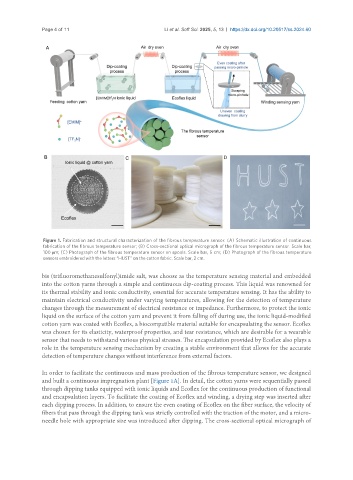
                Figure 1. Fabrication and structural characterization of the fibrous temperature sensor. (A) Schematic illustration of continuous
                fabrication of the fibrous temperature sensor; (B) Cross-sectional optical micrograph of the fibrous temperature sensor. Scale bar,
                100 μm; (C) Photograph of the fibrous temperature sensor on spools. Scale bar, 5 cm; (D) Photograph of the fibrous temperature
                sensors embroidered with the letters “HUST” on the cotton fabric. Scale bar, 2 cm.

               bis (trifluoromethanesulfonyl)imide salt, was choose as the temperature sensing material and embedded
               into the cotton yarns through a simple and continuous dip-coating process. This liquid was renowned for
               its thermal stability and ionic conductivity, essential for accurate temperature sensing. It has the ability to
               maintain electrical conductivity under varying temperatures, allowing for the detection of temperature
               changes through the measurement of electrical resistance or impedance. Furthermore, to protect the ionic
               liquid on the surface of the cotton yarn and prevent it from falling off during use, the ionic liquid-modified
               cotton yarn was coated with Ecoflex, a biocompatible material suitable for encapsulating the sensor. Ecoflex
               was chosen for its elasticity, waterproof properties, and tear resistance, which are desirable for a wearable
               sensor that needs to withstand various physical stresses. The encapsulation provided by Ecoflex also plays a
               role in the temperature sensing mechanism by creating a stable environment that allows for the accurate
               detection of temperature changes without interference from external factors.


               In order to facilitate the continuous and mass production of the fibrous temperature sensor, we designed
               and built a continuous impregnation plant [Figure 1A]. In detail, the cotton yarns were sequentially passed
               through dipping tanks equipped with ionic liquids and Ecoflex for the continuous production of functional
               and encapsulation layers. To facilitate the coating of Ecoflex and winding, a drying step was inserted after
               each dipping process. In addition, to ensure the even coating of Ecoflex on the fiber surface, the velocity of
               fibers that pass through the dipping tank was strictly controlled with the traction of the motor, and a micro-
               needle hole with appropriate size was introduced after dipping. The cross-sectional optical micrograph of

