


Page 116 - Read Online
P. 116
Page 6 of 57                                                        Zheng et al. Soft Sci. 2026, 6, 32


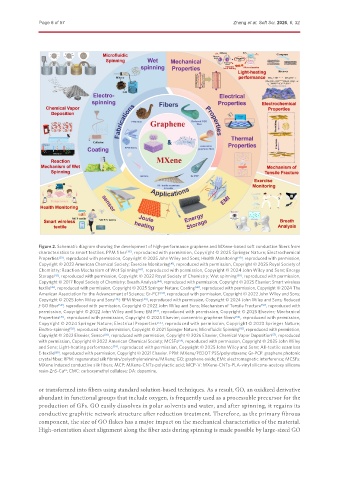
               Figure 2. Schematic diagram showing the development of high-performance graphene and MXene-based soft conductive fibers from
               characteristics to smart textiles. PPM fiber [35] , reproduced with permission, Copyright © 2025 Springer Nature; Electrochemical
               Properties [39] , reproduced with permission, Copyright © 2025 John Wiley and Sons; Health Monitoring [40] , reproduced with permission,
               Copyright © 2023 American Chemical Society; Exercise Monitoring [41] , reproduced with permission, Copyright © 2025 Royal Society of
               Chemistry; Reaction Mechanism of Wet Spinning [42] , reproduced with permission, Copyright © 2024 John Wiley and Sons; Energy
               Storage [43] , reproduced with permission, Copyright © 2022 Royal Society of Chemistry; Wet spinning [30] , reproduced with permission,
               Copyright © 2017 Royal Society of Chemistry; Breath Analysis [44] , reproduced with permission, Copyright © 2025 Elsevier; Smart wireless
               textile [45] , reproduced with permission, Copyright © 2025 Springer Nature; Coating [46] , reproduced with permission, Copyright © 2024 The
               American Association for the Advancement of Science; Gr-PCF [47] , reproduced with permission, Copyright © 2022 John Wiley and Sons;
               Copyright © 2025 John Wiley and Sons [48] ; RPM fibers [49] , reproduced with permission, Copyright © 2024 John Wiley and Sons; Reduced
               f-GO fiber [50] , reproduced with permission, Copyright © 2022 John Wiley and Sons; Mechanism of Tensile Fracture  [50] , reproduced with
               permission, Copyright © 2022 John Wiley and Sons; EMI [51] , reproduced with permission, Copyright © 2025 Elsevier; Mechanical
               Properties  [51] , reproduced with permission, Copyright © 2025 Elsevier; concentric graphene fibers [52] , reproduced with permission,
               Copyright © 2024 Springer Nature; Electrical Properties  [53] , reproduced with permission, Copyright © 2023 Springer Nature;
               Electro-spinning [54] , reproduced with permission, Copyright © 2021 Springer Nature; Microfluidic Spinning [55] , reproduced with permission,
               Copyright © 2022 Elsevier; Sensor [56] , reproduced with permission, Copyright © 2026 Elsevier; Chemical Vapor Deposition [57] , reproduced
               with permission, Copyright © 2022 American Chemical Society; MCSFs [58] , reproduced with permission, Copyright © 2025 John Wiley
               and Sons; Light-heating performance [59] , reproduced with permission, Copyright © 2025 John Wiley and Sons; All-textile seamless
               E-textile [60] , reproduced with permission, Copyright © 2021 Elsevier. PPM: MXene/PEDOT:PSS/polyrotaxane; Gr-PCF: graphene photonic
               crystal fiber; RPM: regenerated silk fibroin/polyethyleneimine/MXene; GO: graphene oxide; EMI: electromagnetic interference; MCSFs:
               MXene induced conductive silk fibers; MCP: MXene-CNTs-polylactic acid; MCP-V: MXene-CNTs-PLA-vinyl silicone-acetoxy silicone
               resin-ZnS-Cu ; CMC: carboxymethyl cellulose; DA: dopamine.
                        2+
               or transformed into fibers using standard solution-based techniques. As a result, GO, an oxidized derivative
               abundant in functional groups that include oxygen, is frequently used as a processable precursor for the
               production of GFs. GO easily dissolves in polar solvents and water, and after spinning, it regains its
               conductive graphitic network structure after reduction treatment. Therefore, as the primary fibrous
               component, the size of GO flakes has a major impact on the mechanical characteristics of the material.
               High-orientation sheet alignment along the fiber axis during spinning is made possible by large-sized GO

