


Page 117 - Read Online
P. 117
Zheng et al. Soft Sci. 2026, 6, 32                                                Page 7 of 57


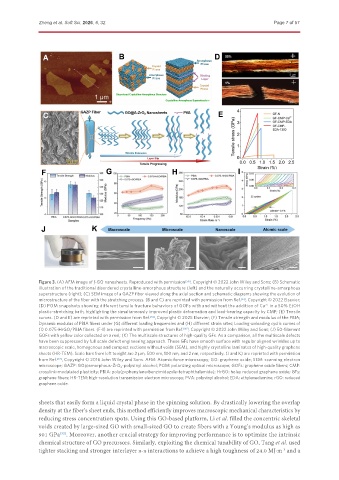
               Figure 3. (A) AFM image of f-GO nanosheets. Reproduced with permission  [50] , Copyright © 2022 John Wiley and Sons; (B) Schematic
               illustration of the traditional disordered crystalline-amorphous structure (left) and the naturally occurring crystalline-amorphous
               superstructure (right); (C) SEM image of a GAZP fiber viewed along the axial section and schematic diagrams showing the evolution of
               microstructure of the fiber with the stretching process. (B and C) are reprinted with permission from Ref. [61] , Copyright © 2022 Elsevier;
               (D) POM snapshots showing different tensile fracture behaviors of GOFs with and without the addition of Ca  in a 50% EtOH
                                                                                              2+
               plastic-stretching bath, highlighting the simultaneously improved plastic deformation and load-bearing capacity by CMP; (E) Tensile
               curves. (D and E) are reprinted with permission from Ref. [51] , Copyright © 2025 Elsevier; (F) Tensile strength and modulus of the PBIA;
               Dynamic modulus of PBIA fibers under (G) different loading frequencies and (H) different strain rates; Loading-unloading cyclic curves of
               (I) 0.075-HrGO/PBIA fibers. (F-I) are reprinted with permission from Ref. [62] , Copyright © 2022 John Wiley and Sons; (J) 50-filament
               GOFs with yellow color collected on a reel; (K) The multiscale structures of high-quality GFs. As a comparison, all the multiscale defects
               have been suppressed by full scale defect engineering approach. These GFs have smooth surface with regular aligned wrinkles up to
               macroscopic scale, homogenous and compact sections without voids (SEM), and highly crystalline laminates of high-quality graphene
               sheets (HR-TEM). Scale bars from left to right are 2 μm, 500 nm, 100 nm, and 2 nm, respectively. (J and K) are reprinted with permission
               from Ref.  [17] , Copyright © 2016 John Wiley and Sons. AFM: Atomic force microscopy; GO: graphene oxide; SEM: scanning electron
               microscope; GAZP: GO@amorphous-ZrO 2 -polyvinyl alcohol; POM: polarizing optical microscope; GOFs: graphene oxide fibers; CMP:
               crosslink-modulated plasticity; PBIA: poly(p-phenylene-benzimidazole-tetraphthalamide); HrGO: holey reduced graphene oxide; GFs:
               graphene fibers; HR-TEM: high-resolution transmission electron microscopy; PVA: polyvinyl alcohol; EDA: ethylenediamine; rGO: reduced
               graphene oxide.

               sheets that easily form a liquid crystal phase in the spinning solution. By drastically lowering the overlap
               density at the fiber’s sheet ends, this method efficiently improves macroscopic mechanical characteristics by
               reducing stress concentration spots. Using this GO-based platform, Li et al. filled the concentric skeletal
               voids created by large-sized GO with small-sized GO to create fibers with a Young’s modulus as high as
               901 GPa . Moreover, another crucial strategy for improving performance is to optimize the intrinsic
                      [52]
               chemical structure of GO precursors. Similarly, exploiting the chemical tunability of GO, Tang et al. used
               tighter stacking and stronger interlayer π-π interactions to achieve a high toughness of 24.0 MJ·m  and a
                                                                                                    -3

