


Page 120 - Read Online
P. 120
Page 10 of 57                                                       Zheng et al. Soft Sci. 2026, 6, 32


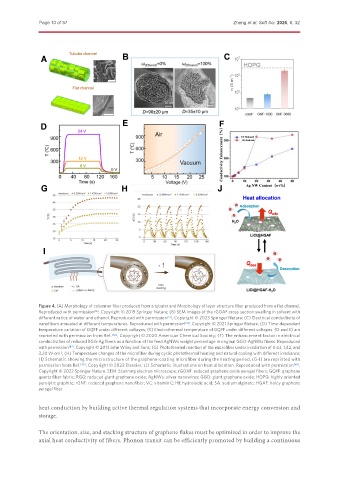
               Figure 4. (A) Morphology of columnar fiber produced from a tubular and Morphology of layer structure fiber produced from a flat channel.
               Reproduced with permission [16] , Copyright © 2019 Springer Nature; (B) SEM images of the rGOAF cross section swelling in solvent with
               different ratios of water and ethanol. Reproduced with permission [53] , Copyright © 2023 Springer Nature; (C) Electrical conductivity of
               nanofibers annealed at different temperatures. Reproduced with permission [54] , Copyright © 2021 Springer Nature; (D) Time-dependent
               temperature variation of GQFF under different voltages; (E) Electrothermal temperature of GQFF under different voltages. (D and E) are
               reprinted with permission from Ref. [66] , Copyright © 2020 American Chemical Society; (F) The enhancement factor in electrical
               conductivities of reduced RGG-Ag fibers as a function of the feed AgNWs weight percentage in original GGO-AgNWs fibers. Reproduced
               with permission [67] , Copyright © 2013 John Wiley and Sons; (G) Photothermal reaction of the microfiber under irradiation of 0.63, 1.42, and
               3.20 W·cm ; (H) Temperature changes of the microfiber during cyclic photothermal heating and natural cooling with different irradiance;
                      -2
               (I) Schematic showing the microstructure of the graphene-coating microfiber during the heating period. (G-I) are reprinted with
               permission from Ref. [55] , Copyright © 2022 Elsevier; (J) Schematic illustrations on heat allocation. Reproduced with permission [68] ,
               Copyright © 2022 Springer Nature. SEM: Scanning electron microscope; rGOAF: reduced graphene oxide aerogel fibers; GQFF: graphene
               quartz fiber fabric; RGG: reduced giant graphene oxide; AgNWs: silver nanowires; GGO: giant graphene oxide; HOPG: highly oriented
               pyrolytic graphite; rGNF: reduced graphene nanofiber; VC: vitamin C; HI: hydroiodic acid; SA: sodium alginate; HGAF: holey graphene
               aerogel fiber.

               heat conduction by building active thermal regulation systems that incorporate energy conversion and
               storage.


               The orientation, size, and stacking structure of graphene flakes must be optimized in order to improve the
               axial heat conductivity of fibers. Phonon transit can be efficiently promoted by building a continuous

