


Page 111 - Read Online
P. 111
Review Article  |  Open Access

                                                 Soft Science


                                           Zheng et al. Soft Sci. 2026, 6, 32      DOI:10.20517/ss.2025.157


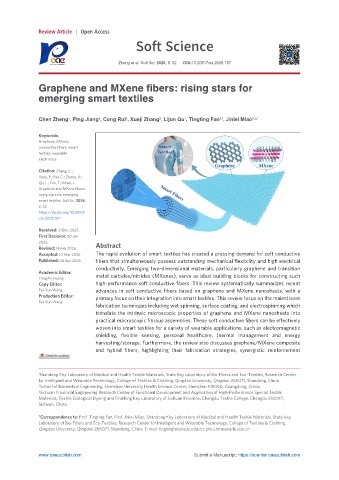
               Graphene and MXene fibers: rising stars for
               emerging smart textiles


               Chen Zheng , Ping Jiang , Cong Rui , Xueji Zhang , Lijun Qu , Tingting Fan , Jinlei Miao 1,3,*
                         1
                                                         2
                                                                  1
                                                                              1,*
                                             1
                                    1
               Keywords:
               Graphene, MXene,
               conductive fibers, smart
               textiles, wearable
               electronics
               Citation: Zheng, C.;
               Jiang, P.; Rui, C.; Zhang, X.;
               Qu, L.; Fan, T.; Miao, J.
               Graphene and MXene fibers:
               rising stars for emerging
               smart textiles. Soft Sci. 2026,
               6, 32.
               https://dx.doi.org/10.20517
               /ss.2025.157

               Received: 31 Dec 2025
               First Decision: 30 Jan
               2026                Abstract
               Revised: 14 Feb 2026
               Accepted: 10 Mar 2026  The rapid evolution of smart textiles has created a pressing demand for soft conductive
               Published: 28 Apr 2026  fibers that simultaneously possess outstanding mechanical flexibility and high electrical
                                   conductivity.  Emerging  two-dimensional  materials,  particularly  graphene  and  transition
               Academic Editor:    metal  carbides/nitrides  (MXenes),  serve  as  ideal  building  blocks  for  constructing  such
               YongAn Huang
               Copy Editor:        high-performance soft conductive fibers. This review systematically summarizes recent
               Pei-Yun Wang        advances   in   soft   conductive   fibers   based   on   graphene   and   MXene   nanosheets,   with   a
               Production Editor:  primary focus on their integration into smart textiles. This review focus on the mainstream
               Pei-Yun Wang
                                   fabrication techniques including wet spinning, surface coating, and electrospinning which
                                   translate  the  intrinsic  microscopic  properties  of  graphene  and  MXene  nanosheets  into
                                   practical macroscopic fibrous assemblies. These soft conductive fibers can be effectively
                                   woven into smart textiles for a variety of wearable applications, such as electromagnetic
                                   shielding,   flexible   sensing,   personal   healthcare,   thermal   management   and   energy
                                   harvesting/storage. Furthermore, the review also discusses graphene/MXene composite
                                   and   hybrid   fibers,   highlighting   their   fabrication   strategies,   synergistic   reinforcement


               1 Shandong Key Laboratory of Medical and Health Textile Materials, State Key Laboratory of Bio-Fibers and Eco-Textiles, Research Center
               for Intelligent and Wearable Technology, College of Textiles & Clothing, Qingdao University, Qingdao 266071, Shandong, China.
               2 School of Biomedical Engineering, Shenzhen University Health Science Center, Shenzhen 518060, Guangdong, China.
               3 Sichuan Provincial Engineering Research Center of Functional Development and Application of High-Performance Special Textile
               Materials, Textile Ecological Dyeing and Finishing Key Laboratory of Sichuan Province, Chengdu Textile College, Chengdu 610097,
               Sichuan, China.

               * Correspondence to: Prof. Tingting Fan, Prof. Jinlei Miao, Shandong Key Laboratory of Medical and Health Textile Materials, State Key
               Laboratory of Bio-Fibers and Eco-Textiles, Research Center for Intelligent and Wearable Technology, College of Textiles & Clothing,
               Qingdao University, Qingdao 266071, Shandong, China. E-mail: tingtingfan@qdu.edu.cn; jinlei.miao@qdu.edu.cn


               www.oaepublish.com                                    Submit a Manuscript: https://ucenter.oaepublish.com

