


Page 143 - Read Online
P. 143
Page 20 of 26                           Sun et al. Soft Sci. 2025, 5, 18  https://dx.doi.org/10.20517/ss.2024.77

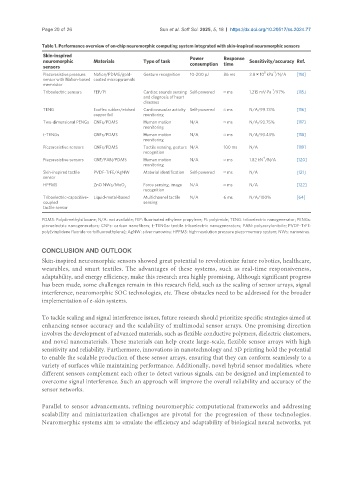
               Table 1. Performance overview of on-chip neuromorphic computing system integrated with skin-inspired neuromorphic sensors
                Skin-inspired                                    Power      Response
                neuromorphic     Materials       Type of task    consumption  time   Sensitivity/accuracy Ref.
                sensors
                                                                                          5
                                                                                             -1
                Piezoresistive pressure   Nafion/PDMS/gold-  Gesture recognition  10-200 pJ  86 ms  3.8 × 10  kPa /N/A  [114]
                sensor with Nafion-based  coated micropyramids
                memristor
                                                                                             -1
                Triboelectric sensors  FEP/PI    Cardiac sounds sensing  Self-powered  ≈ ms  1,215 mV·Pa /97%  [115]
                                                 and diagnosis of heart
                                                 diseases
                TENG             Ecoflex rubber/etched   Cardiovascular activity  Self-powered  ≈ ms  N/A/99.73%  [116]
                                 copper foil     monitoring
                Two-dimensional PENGs  CNFs/PDMS  Human motion   N/A        ≈ ms     N/A/93.75%      [117]
                                                 monitoring
                t-TENGs          CNFs/PDMS       Human motion    N/A        ≈ ms     N/A/93.43%      [118]
                                                 monitoring
                Piezoresistive sensors  CNFs/PDMS  Tactile sensing, gesture  N/A  100 ms  N/A        [119]
                                                 recognition
                                                                                          -1
                Piezoresistive sensors  CNF/PAN/PDMS  Human motion   N/A    ≈ ms     1.82 kN /N/A    [120]
                                                 monitoring
                Skin-inspired tactile   PVDF-TrFE/AgNW  Material identification  Self-powered  ≈ ms  N/A  [121]
                sensor
                HPPMS            ZnO NWs/MoO     Force sensing, image   N/A  ≈ ms    N/A             [122]
                                           3
                                                 recognition
                Triboelectric-capacitive-  Liquid-metal-based  Multichannel tactile   N/A  6 ms  N/A/100%  [64]
                coupled                          sensing
                tactile sensor

               PDMS: Polydimethylsiloxane; N/A: not available; FEP: fluorinated ethylene propylene; PI: polyimide; TENG: triboelectric nanogenerator; PENGs:
               piezoelectric nanogenerators; CNFs: carbon nanofibers; t-TENGs: textile triboelectric nanogenerators; PAN: polyacrylonitrile; PVDF-TrFE:
               poly(vinylidene fluoride-co-trifluoroethylene); AgNW: silver nanowire; HPPMS: high-resolution pressure piezo-memory system; NWs: nanowires.


               CONCLUSION AND OUTLOOK
               Skin-inspired neuromorphic sensors showed great potential to revolutionize future robotics, healthcare,
               wearables, and smart textiles. The advantages of these systems, such as real-time responsiveness,
               adaptability, and energy efficiency, make this research area highly promising. Although significant progress
               has been made, some challenges remain in this research field, such as the scaling of sensor arrays, signal
               interference, neuromorphic SOC technologies, etc. These obstacles need to be addressed for the broader
               implementation of e-skin systems.


               To tackle scaling and signal interference issues, future research should prioritize specific strategies aimed at
               enhancing sensor accuracy and the scalability of multimodal sensor arrays. One promising direction
               involves the development of advanced materials, such as flexible conductive polymers, dielectric elastomers,
               and novel nanomaterials. These materials can help create large-scale, flexible sensor arrays with high
               sensitivity and reliability. Furthermore, innovations in nanotechnology and 3D printing hold the potential
               to enable the scalable production of these sensor arrays, ensuring that they can conform seamlessly to a
               variety of surfaces while maintaining performance. Additionally, novel hybrid sensor modalities, where
               different sensors complement each other to detect various signals, can be designed and implemented to
               overcome signal interference. Such an approach will improve the overall reliability and accuracy of the
               sensor networks.


               Parallel to sensor advancements, refining neuromorphic computational frameworks and addressing
               scalability and miniaturization challenges are pivotal for the progression of these technologies.
               Neuromorphic systems aim to emulate the efficiency and adaptability of biological neural networks, yet

