


Page 139 - Read Online
P. 139
Page 16 of 26                           Sun et al. Soft Sci. 2025, 5, 18  https://dx.doi.org/10.20517/ss.2024.77


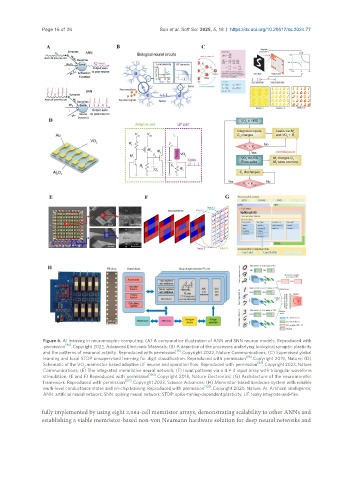
                Figure 6. AI learning in neuromorphic computing. (A) A comparative illustration of ANN and SNN neuron models. Reproduced with
                permission [96] . Copyright 2022, Advanced Electronic Materials; (B) A depiction of the processes underlying biological synaptic plasticity
                and the patterns of neuronal activity. Reproduced with permission [95] .Copyright 2022, Nature Communications; (C) Supervised global
                learning and local STDP unsupervised learning for digit classification. Reproduced with  permission [98] . Copyright 2019, Nature; (D)
                Schematic of the VO  memristor-based adaptive LIF neuron and operation flow. Reproduced with permission [99] . Copyright 2023, Nature
                             2
                Communications; (E) The integrated memristive neural network; (F) Input patterns via a 4 × 4 input array with triangular waveform
                stimulation. (E and F) Reproduced with  permission [100] . Copyright 2018, Nature Electronics; (G) Architecture of the neuromorphic
                framework. Reproduced with permission [102] . Copyright 2023, Science Advances; (H) Memristor-based hardware system with reliable
                multi-level conductance states and on-chip training. Reproduced with permission [103] . Copyright 2020, Nature. AI: Artificial intelligence;
                ANN: artificial neural network; SNN: spiking neural network; STDP: spike-timing-dependent plasticity; LIF: leaky integrate-and-fire.


               fully implemented by using eight 2,084-cell memristor arrays, demonstrating scalability to other ANNs and
               establishing a viable memristor-based non-von Neumann hardware solution for deep neural networks and

