


Page 137 - Read Online
P. 137
Page 14 of 26                           Sun et al. Soft Sci. 2025, 5, 18  https://dx.doi.org/10.20517/ss.2024.77


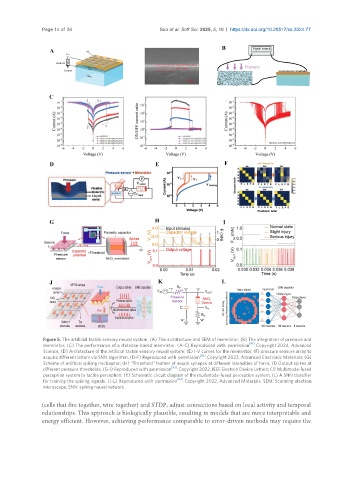
                Figure 5. The artificial tactile sensory neural system. (A) The architecture and SEM of memristor; (B) The integration of pressure and
                memristor; (C) The performance of a chitosan-based memristor. (A-C) Reproduced with  permission [91] . Copyright 2024, Advanced
                Science; (D) Architecture of the artificial tactile sensory neural system; (E) I-V curves for the memristor; (F) pressure sensors array to
                acquire different letters via SNN algorithm. (D-F) Reproduced with permission [92] . Copyright 2022, Advanced Electronic Materials; (G)
                Scheme of artificial spiking nociceptor; (H) “Threshold” feather of neural synapse at different intensities of force; (I) Output spikes at
                different pressure thresholds. (G-I) Reproduced with permission [93] . Copyright 2022, IEEE Electron Device Letters; (J) Multimode-fused
                perception system to tactile perception; (K) Schematic circuit diagram of the multimode-fused perception system; (L) A SNN classifier
                for training the spiking signals. (J-L) Reproduced with  permission [94] . Copyright 2022, Advanced Materials. SEM: Scanning electron
                microscope; SNN: spiking neural network.

               (cells that fire together, wire together) and STDP, adjust connections based on local activity and temporal
               relationships. This approach is biologically plausible, resulting in models that are more interpretable and
               energy efficient. However, achieving performance comparable to error-driven methods may require the

