


Page 119 - Read Online
P. 119
Zhang et al. Soft Sci. 2025, 5, 17  https://dx.doi.org/10.20517/ss.2024.68       Page 9 of 13


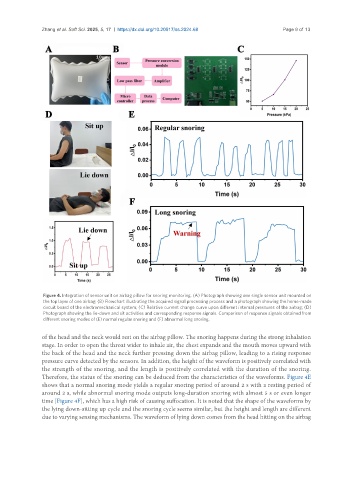
                Figure 4. Integration of sensor unit on airbag pillow for snoring monitoring. (A) Photograph showing one single sensor unit mounted on
                the top layer of one airbag; (B) Flowchart illustrating the acquired signal processing process and a photograph showing the home-made
                circuit board of the electromechanical system; (C) Relative current change curve upon different internal pressures of the airbag; (D)
                Photograph showing the lie-down and sit activities and corresponding response signals. Comparison of response signals obtained from
                different snoring modes of (E) normal regular snoring and (F) abnormal long snoring.

               of the head and the neck would rest on the airbag pillow. The snoring happens during the strong inhalation
               stage. In order to open the throat wider to inhale air, the chest expands and the mouth moves upward with
               the back of the head and the neck further pressing down the airbag pillow, leading to a rising response
               pressure curve detected by the sensors. In addition, the height of the waveform is positively correlated with
               the strength of the snoring, and the length is positively correlated with the duration of the snoring.
               Therefore, the status of the snoring can be deduced from the characteristics of the waveforms. Figure 4E
               shows that a normal snoring mode yields a regular snoring period of around 2 s with a resting period of
               around 2 s, while abnormal snoring mode outputs long-duration snoring with almost 5 s or even longer
               time [Figure 4F], which has a high risk of causing suffocation. It is noted that the shape of the waveforms by
               the lying down-sitting up cycle and the snoring cycle seems similar, but the height and length are different
               due to varying sensing mechanisms. The waveform of lying down comes from the head hitting on the airbag

