


Page 116 - Read Online
P. 116
Page 6 of 13                          Zhang et al. Soft Sci. 2025, 5, 17  https://dx.doi.org/10.20517/ss.2024.68


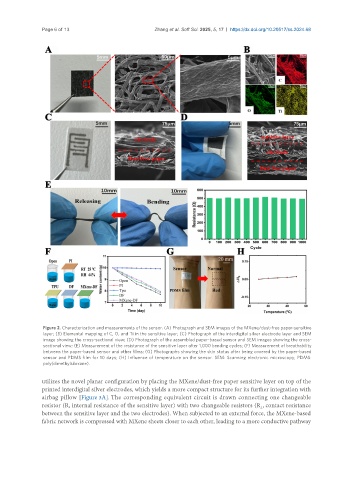
                Figure 2. Characterization and measurements of the sensor. (A) Photograph and SEM images of the MXene/dust-free paper-sensitive
                layer; (B) Elemental mapping of C, O, and Ti in the sensitive layer; (C) Photograph of the interdigital silver electrode layer and SEM
                image showing the cross-sectional view; (D) Photograph of the assembled paper-based sensor and SEM images showing the cross-
                sectional view; (E) Measurement of the resistance of the sensitive layer after 1,000 bending cycles; (F) Measurement of breathability
                between the paper-based sensor and other films; (G) Photographs showing the skin status after being covered by the paper-based
                sensor and PDMS film for 10 days; (H) Influence of temperature on the sensor. SEM: Scanning electronic microscopy; PDMS:
                poly(dimethylsiloxane).

               utilizes the novel planar configuration by placing the MXene/dust-free paper sensitive layer on top of the
               printed interdigital silver electrodes, which yields a more compact structure for its further integration with
               airbag pillow [Figure 3A]. The corresponding equivalent circuit is drawn connecting one changeable
               resistor (R, internal resistance of the sensitive layer) with two changeable resistors (R , contact resistance
                                                                                         ±
               between the sensitive layer and the two electrodes). When subjected to an external force, the MXene-based
               fabric network is compressed with MXene sheets closer to each other, leading to a more conductive pathway

