


Page 117 - Read Online
P. 117
Zhang et al. Soft Sci. 2025, 5, 17  https://dx.doi.org/10.20517/ss.2024.68       Page 7 of 13


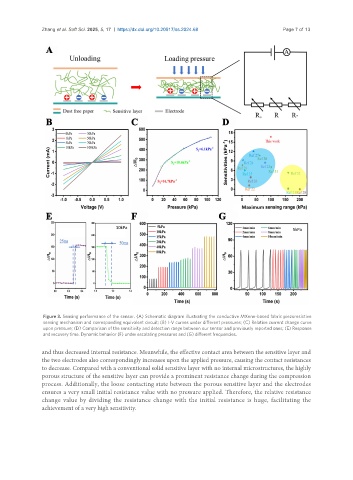
                Figure 3. Sensing performance of the sensor. (A) Schematic diagram illustrating the conductive MXene-based fabric piezoresistive
                sensing mechanism and corresponding equivalent circuit; (B) I-V curves under different pressures; (C) Relative current change curve
                upon pressure; (D) Comparison of the sensitivity and detection range between our sensor and previously reported ones; (E) Response
                and recovery time. Dynamic behavior (F) under escalating pressures and (G) different frequencies.

               and thus decreased internal resistance. Meanwhile, the effective contact area between the sensitive layer and
               the two electrodes also correspondingly increases upon the applied pressure, causing the contact resistances
               to decrease. Compared with a conventional solid sensitive layer with no internal microstructures, the highly
               porous structure of the sensitive layer can provide a prominent resistance change during the compression
               process. Additionally, the loose contacting state between the porous sensitive layer and the electrodes
               ensures a very small initial resistance value with no pressure applied. Therefore, the relative resistance
               change value by dividing the resistance change with the initial resistance is huge, facilitating the
               achievement of a very high sensitivity.

