


Page 10 - Read Online
P. 10
Page 8 of 11                             Kim et al. Soft Sci 2024;4:12  https://dx.doi.org/10.20517/ss.2023.50


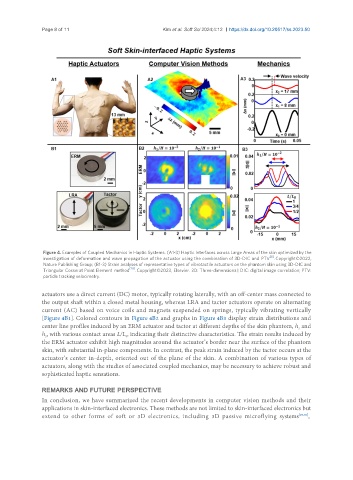
                Figure 4. Examples of Coupled Mechanics in Haptic Systems. (A1-3) Haptic Interfaces across Large Areas of the skin optimized by the
                                                                                            [8]
                investigation of deformation and wave propagation of the actuator using the combination of 3D-DIC and  PTV . Copyright©2022,
                Nature Publishing Group; (B1-3) Strain analyses of representative types of vibrotactile actuators on the phantom skin using 3D-DIC and
                Triangular Cosserat Point Element  method [28] . Copyright©2023, Elsevier. 3D: Three-dimensional; DIC: digital image correlation; PTV:
                particle tracking velocimetry.

               actuators use a direct current (DC) motor, typically rotating laterally, with an off-center mass connected to
               the output shaft within a closed metal housing, whereas LRA and tactor actuators operate on alternating
               current (AC) based on voice coils and magnets suspended on springs, typically vibrating vertically
               [Figure 4B1]. Colored contours in Figure 4B2 and graphs in Figure 4B3 display strain distributions and
               center line profiles induced by an ERM actuator and tactor at different depths of the skin phantom, h  and
                                                                                                      1
               h , with various contact areas L/L , indicating their distinctive characteristics. The strain results induced by
                2
                                           0
               the ERM actuator exhibit high magnitudes around the actuator’s border near the surface of the phantom
               skin, with substantial in-plane components. In contrast, the peak strain induced by the tactor occurs at the
               actuator’s center in-depth, oriented out of the plane of the skin. A combination of various types of
               actuators, along with the studies of associated coupled mechanics, may be necessary to achieve robust and
               sophisticated haptic sensations.


               REMARKS AND FUTURE PERSPECTIVE
               In conclusion, we have summarized the recent developments in computer vision methods and their
               applications in skin-interfaced electronics. These methods are not limited to skin-interfaced electronics but
               extend  to  other  forms  of  soft  or  3D  electronics,  including  3D  passive  microflying  systems [29,30] ,

