


Page 44 - Read Online
P. 44
Page 10 of 34                             Bai et al. Soft Sci 2023;3:40  https://dx.doi.org/10.20517/ss.2023.38


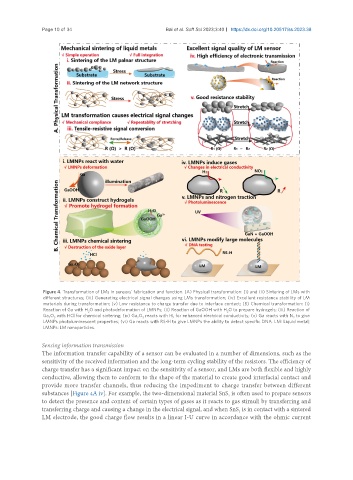
                Figure 4. Transformation of LMs in sensors’ fabrication and function. (A) Physical transformation: (i) and (ii) Sintering of LMs with
                different structures; (iii) Generating electrical signal changes using LMs transformation; (iv) Excellent resistance stability of LM
                materials during transformation; (v) Low resistance to charge transfer due to interface contact; (B) Chemical transformation: (i)
                Reaction of Ga with H O and photodeformation of LMNPs; (ii) Reaction of GaOOH with H O to prepare hydrogels; (iii) Reaction of
                               2
                                                                             2
                Ga O  with HCl for chemical sintering; (iv) Ga O  reacts with H  for enhanced electrical conductivity; (v) Ga reacts with N  to give
                                               2
                   3
                 2
                                                                                                    2
                                                           2
                                                 3
                LMNPs photoluminescent properties; (vi) Ga reacts with RS-H to give LMNPs the ability to detect specific DNA. LM: Liquid metal;
                LMNPs: LM nanoparticles.
               Sensing information transmission
               The information transfer capability of a sensor can be evaluated in a number of dimensions, such as the
               sensitivity of the received information and the long-term cycling stability of the resistors. The efficiency of
               charge transfer has a significant impact on the sensitivity of a sensor, and LMs are both flexible and highly
               conductive, allowing them to conform to the shape of the material to create good interfacial contact and
               provide more transfer channels, thus reducing the impediment to charge transfer between different
               substances [Figure 4A iv]. For example, the two-dimensional material SnS  is often used to prepare sensors
                                                                              2
               to detect the presence and content of certain types of gases as it reacts to gas stimuli by transferring and
               transferring charge and causing a change in the electrical signal, and when SnS  is in contact with a sintered
                                                                                  2
               LM electrode, the good charge flow results in a linear I-U curve in accordance with the ohmic current

