


Page 47 - Read Online
P. 47
Bai et al. Soft Sci 2023;3:40  https://dx.doi.org/10.20517/ss.2023.38            Page 13 of 34

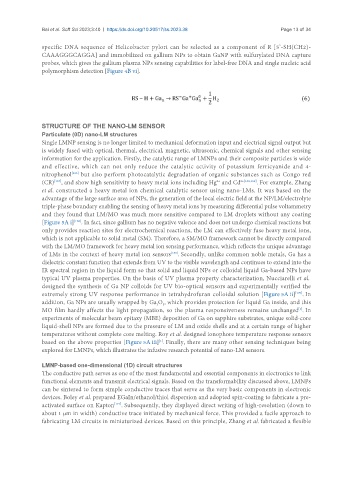
               specific DNA sequence of Helicobacter pylori can be selected as a component of R [5’-SH(CH2)-
               CAAAGGGCAGGA] and immobilized on gallium NPs to obtain GaNP with sulfurylated DNA capture
               probes, which gives the gallium plasma NPs sensing capabilities for label-free DNA and single nucleic acid
               polymorphism detection [Figure 4B vi].


               STRUCTURE OF THE NANO-LM SENSOR
               Particulate (0D) nano-LM structures
               Single LMNP sensing is no longer limited to mechanical deformation input and electrical signal output but
               is widely fused with optical, thermal, electrical, magnetic, ultrasonic, chemical signals and other sensing
               information for the application. Firstly, the catalytic range of LMNPs and their composite particles is wide
               and effective, which can not only reduce the catalytic activity of potassium ferricyanide and 4-
                         [166]
               nitrophenol  but also perform photocatalytic degradation of organic substances such as Congo red
                   [167]
               (CR) , and show high sensitivity to heavy metal ions including Hg  and Cd 2+[168,169] . For example, Zhang
                                                                          2+
               et al. constructed a heavy metal ion chemical catalytic sensor using nano-LMs. It was based on the
               advantage of the large surface area of NPs, the generation of the local electric field at the NP/LM/electrolyte
               triple-phase boundary enabling the sensing of heavy metal ions by measuring differential pulse voltammetry
               and they found that LM/MO was much more sensitive compared to LM droplets without any coating
               [Figure 5A i] . In fact, since gallium has no negative valence and does not undergo chemical reactions but
                          [168]
               only provides reaction sites for electrochemical reactions, the LM can effectively fuse heavy metal ions,
               which is not applicable to solid metal (SM). Therefore, a SM/MO framework cannot be directly compared
               with the LM/MO framework for heavy metal ion sensing performance, which reflects the unique advantage
               of LMs in the context of heavy metal ion sensors . Secondly, unlike common noble metals, Ga has a
                                                           [168]
               dielectric constant function that extends from UV to the visible wavelength and continues to extend into the
               IR spectral region in the liquid form so that solid and liquid NPs or colloidal liquid Ga-based NPs have
               typical UV plasma properties. On the basis of UV plasma property characterization, Nucciarelli et al.
               designed the synthesis of Ga NP colloids for UV bio-optical sensors and experimentally verified the
                                                                                                     [170]
               extremely strong UV response performance in tetrahydrofuran colloidal solution [Figure 5A ii] . In
               addition, Ga NPs are usually wrapped by Ga O , which provides protection for liquid Ga inside, and this
                                                        3
                                                      2
                                                                                                      [1]
               MO film hardly affects the light propagation, so the plasma responsiveness remains unchanged . In
               experiments of molecular beam epitaxy (MBE) deposition of Ga on sapphire substrates, unique solid-core
               liquid-shell NPs are formed due to the pressure of LM and oxide shells and at a certain range of higher
               temperatures without complete core melting. Roy et al. designed ionophore temperature response sensors
               based on the above properties [Figure 5A iii] . Finally, there are many other sensing techniques being
                                                       [1]
               explored for LMNPs, which illustrates the infusive research potential of nano-LM sensors.

               LMNP-based one-dimensional (1D) circuit structures
               The conductive path serves as one of the most fundamental and essential components in electronics to link
               functional elements and transmit electrical signals. Based on the transformability discussed above, LMNPs
               can be sintered to form simple conductive traces that serve as the very basic components in electronic
               devices. Boley et al. prepared EGaIn/ethanol/thiol dispersion and adopted spin-coating to fabricate a pre-
               activated surface on Kapton . Subsequently, they displayed direct writing of high-resolution (down to
                                        [171]
               about 1 μm in width) conductive trace initiated by mechanical force. This provided a facile approach to
               fabricating LM circuits in miniaturized devices. Based on this principle, Zhang et al. fabricated a flexible

