


Page 73 - Read Online
P. 73
Page 16 of 23                             Du et al. Soft Sci 2024;4:35  https://dx.doi.org/10.20517/ss.2024.31


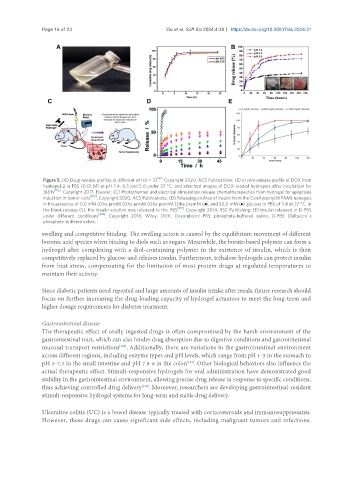
                Figure 5. (A) Drug release profiles at different pH (n = 3) [91] . Copyright 2020, ACS Publications; (B) In vitro release profile of DOX from
                hydrogel-2 in PBS (0.01 M) at pH 7.4, 6.5 and 5.0 under 37 °C, and attached images of DOX-loaded hydrogels after incubation for
                168 h [102] . Copyright 2017, Elsevier; (C) Photothermal and electrical stimulation release chemotherapeutics from hydrogel for apoptosis
                induction in tumor cells [103] . Copyright 2020, ACS Publications; (D) Releasing profiles of insulin from the ConA@poly(NIPAM) nanogels
                in the presence of 0.0 mM ((the prmM ((the prmM ((the premM ((the premM ( ), and 20.0 mM ( ) glucose in PBS of 7.4 at 37 °C. In
                the blank release (◊), the insulin solution was released to the  PBS [105] . Copyright 2014, RSC Publishing; (E) Insulin released in D-PBS
                under  different  conditions [104] .  Copyright  2018,  Wiley.  DOX:  Doxorubicin;  PBS:  phosphate-buffered  saline;  D-PBS:  Dulbecco's
                phosphate-buffered saline.
               swelling and competitive binding. The swelling action is caused by the equilibrium movement of different
               boronic acid species when binding to diols such as sugars. Meanwhile, the borate-based polymer can form a
               hydrogel after complexing with a diol-containing polymer in the existence of insulin, which is then
               competitively replaced by glucose and releases insulin. Furthermore, trehalose hydrogels can protect insulin
               from heat stress, compensating for the limitation of most protein drugs at regulated temperatures to
               maintain their activity.

               Since diabetic patients need repeated and large amounts of insulin intake after meals, future research should
               focus on further increasing the drug-loading capacity of hydrogel actuators to meet the long-term and
               higher dosage requirements for diabetes treatment.

               Gastrointestinal disease
               The therapeutic effect of orally ingested drugs is often compromised by the harsh environment of the
               gastrointestinal tract, which can also hinder drug absorption due to digestive conditions and gastrointestinal
               mucosal transport restrictions . Additionally, there are variations in the gastrointestinal environment
                                         [122]
               across different regions, including enzyme types and pH levels, which range from pH 1-3 in the stomach to
                                                                [123]
               pH 5-7.5 in the small intestine and pH 7.8-8 in the colon . Other biological behaviors also influence the
               actual therapeutic effect. Stimuli-responsive hydrogels for oral administration have demonstrated good
               stability in the gastrointestinal environment, allowing precise drug release in response to specific conditions,
               thus achieving controlled drug delivery . Moreover, researchers are developing gastrointestinal-resident
                                                 [124]
               stimuli-responsive hydrogel systems for long-term and stable drug delivery.

               Ulcerative colitis (UC) is a bowel disease typically treated with corticosteroids and immunosuppressants.
               However, these drugs can cause significant side effects, including malignant tumors and infections.

