


Page 46 - Read Online
P. 46
Ma et al. Soft Sci 2024;4:26  https://dx.doi.org/10.20517/ss.2024.20             Page 23 of 34

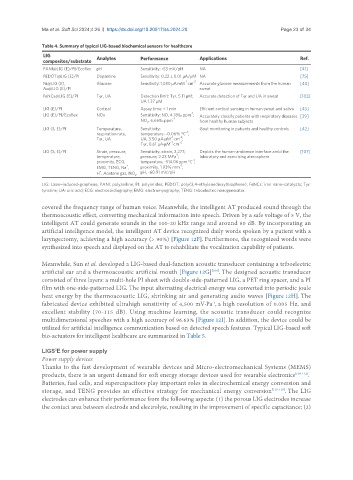
               Table 4. Summary of typical LIG-based biochemical sensors for healthcare
                LIG               Analytes      Performance         Applications                      Ref.
                composites/substrate
                PANI@LIG (E)/PI/Ecoflex  pH     Sensitivity: -53 mV/pH  NA                            [41]
                PEDOT@LIG (E)/PI  Dopamine      Sensitivity: 0.22 ± 0.01 μA/μM NA                     [75]
                                                               -1  -2
                Ni@LIG (E),       Glucose       Sensitivity: 1,080 μA·mM ·cm  Accurate glucose measurements from the human   [40]
                Au@LIG (E)/PI                                       sweat
                FeNCs@LIG (E)/PI  Tyr, UA       Detection limit: Tyr, 5.11 μM;   Accurate detection of Tyr and UA in sweat  [103]
                                                UA 1.37 μM
                LIG (E)/PI        Cortisol      Assay time: < 1 min  Efficient cortisol sensing in human sweat and saliva  [43]
                                                                  -1
                LIG (E)/PI/Ecoflex  NOx         Sensitivity: NO, 4.18‰ ppm ;  Accurately classify patients with respiratory diseases  [39]
                                                           -1
                                                NO , 6.66‰ ppm      from healthy human subjects
                                                   2
                LIG (S, E)/PI     Temperature,   Sensitivity:       Gout monitoring in patients and healthy controls  [42]
                                                                -1
                                  respiration rate,   temperature: -0.06% °C ;
                                                           -1  -2
                                  Tyr, UA       UA, 3.50 μA·μM ·cm ;
                                                          -1  -2
                                                Tyr, 0.61 μA·μM ·cm
                LIG (S, E)/PI     Strain, pressure,  Sensitivity: strain, 2.277;   Depicts the human-ambience interface amid the   [107]
                                                            -1
                                  temperature,  pressure, 2.23 MPa ;   laboratory and exercising atmosphere
                                                                  -1
                                  proximity, ECG,   temperature, -514.06 ppm °C ;
                                            +                 -1
                                  EMG, TENG, Na ,   proximity, 1.93% mm ;
                                   +            pH, -60.91 mV/pH
                                  H , Acetone gas, NO 2
               LIG: Laser-induced-graphene; PANI: polyaniline; PI: polyimides; PEDOT: poly(3,4-ethylenedioxythiophene); FeNCs: iron nano-catalysts; Tyr:
               tyrosine; UA: uric acid; ECG: electrocardiography; EMG: electromyography; TENG: triboelectric nanogenerator.
               covered the frequency range of human voice. Meanwhile, the intelligent AT produced sound through the
               thermoacoustic effect, converting mechanical information into speech. Driven by a safe voltage of 5 V, the
               intelligent AT could generate sounds in the 100-20 kHz range and around 60 dB. By incorporating an
               artificial intelligence model, the intelligent AT device recognized daily words spoken by a patient with a
               laryngectomy, achieving a high accuracy (> 90%) [Figure 12F]. Furthermore, the recognized words were
               synthesized into speech and displayed on the AT to rehabilitate the vocalization capability of patients.

               Meanwhile, Sun et al. developed a LIG-based dual-function acoustic transducer containing a triboelectric
               artificial ear and a thermoacoustic artificial mouth [Figure 12G] . The designed acoustic transducer
                                                                        [108]
               consisted of three layers: a multi-hole PI sheet with double-side-patterned LIG, a PET ring spacer, and a PI
               film with one-side-patterned LIG. The input alternating electrical energy was converted into periodic joule
               heat energy by the thermoacoustic LIG, shrinking air and generating audio waves [Figure 12H]. The
               fabricated device exhibited ultrahigh sensitivity of 4,500 mV·Pa , a high resolution of 0.005 Hz, and
                                                                         -1
               excellent stability (70-115 dB). Using machine learning, the acoustic transducer could recognize
               multidimensional speeches with a high accuracy of 96.63% [Figure 12I]. In addition, the device could be
               utilized for artificial intelligence communication based on detected speech features. Typical LIG-based soft
               bio-actuators for intelligent healthcare are summarized in Table 5.

                    2
               LIGS E for power supply
               Power supply devices
               Thanks to the fast development of wearable devices and Micro-electromechanical Systems (MEMS)
               products, there is an urgent demand for soft energy storage devices used for wearable electronics [109-112] .
               Batteries, fuel cells, and supercapacitors play important roles in electrochemical energy conversion and
               storage, and TENG provides an effective strategy for mechanical energy conversion [113-119] . The LIG
               electrodes can enhance their performance from the following aspects: (1) the porous LIG electrodes increase
               the contact area between electrode and electrolyte, resulting in the improvement of specific capacitance; (2)

