


Page 96 - Read Online
P. 96
Xi et al. Soft Sci 2023;3:26  https://dx.doi.org/10.20517/ss.2023.13             Page 5 of 34


                                                                                                       [38]
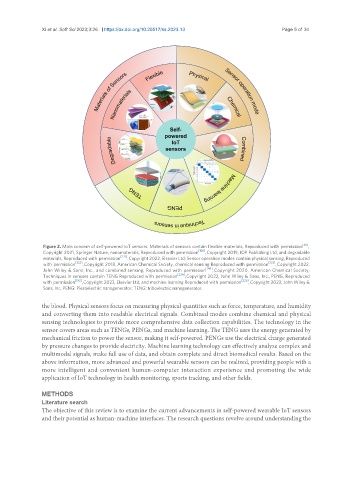
                Figure 2. Main concern of self-powered IoT sensors. Materials of sensors contain flexible materials, Reproduced with  permission  ,
                Copyright 2021, Springer Nature, nanomaterials, Reproduced with permission [106] , Copyright 2019, IOP Publishing Ltd, and degradable
                materials, Reproduced with permission [221] . Copyright 2022, Elsevier Ltd; Sensor operation modes contain physical sensing, Reproduced
                with permission [222] . Copyright 2018, American Chemical Society, chemical sensing Reproduced with permission [223] , Copyright 2022,
                John Wiley & Sons, Inc., and combined sensing, Reproduced with  permission [149] , Copyright 2020, American Chemical Society;
                Techniques in sensors contain TENG Reproduced with  permission [224] , Copyright 2022, John Wiley & Sons, Inc., PENG, Reproduced
                with permission [192] , Copyright 2023, Elsevier Ltd, and machine learning Reproduced with permission [225] , Copyright 2022, John Wiley &
                Sons, Inc. PENG: Piezoelectric nanogenerator; TENG: triboelectric nanogenerator.


               the blood. Physical sensors focus on measuring physical quantities such as force, temperature, and humidity
               and converting them into readable electrical signals. Combined modes combine chemical and physical
               sensing technologies to provide more comprehensive data collection capabilities. The technology in the
               sensor covers areas such as TENGs, PENGs, and machine learning. The TENG uses the energy generated by
               mechanical friction to power the sensor, making it self-powered. PENGs use the electrical charge generated
               by pressure changes to provide electricity. Machine learning technology can effectively analyze complex and
               multimodal signals, make full use of data, and obtain complete and direct biomedical results. Based on the
               above information, more advanced and powerful wearable sensors can be realized, providing people with a
               more intelligent and convenient human-computer interaction experience and promoting the wide
               application of IoT technology in health monitoring, sports tracking, and other fields.

               METHODS
               Literature search
               The objective of this review is to examine the current advancements in self-powered wearable IoT sensors
               and their potential as human-machine interfaces. The research questions revolve around understanding the

