


Page 95 - Read Online
P. 95
Page 4 of 34                              Xi et al. Soft Sci 2023;3:26  https://dx.doi.org/10.20517/ss.2023.13


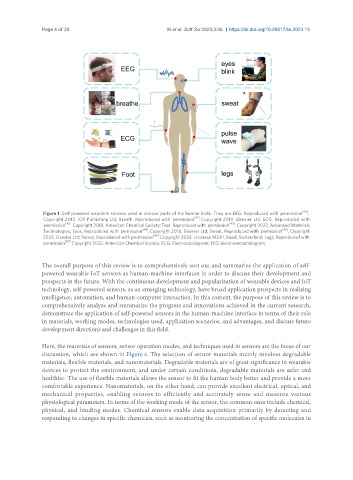
                Figure 1. Self-powered wearable sensors used in various parts of the human body. They are EEG. Reproduced with  permission [40] .
                Copyright 2015, IOP Publishing Ltd; Breath. Reproduced with  permission [41] . Copyright 2019, Elsevier Ltd; ECG. Reproduced with
                permission [42] . Copyright 2018, American Chemical Society; Feet. Reproduced with permission [43] , Copyright 2022, Advanced Materials
                Technologies; Eyes, Reproduced with  permission [44] , Copyright 2018, Elsevier Ltd; Sweat, Reproduced with  permission [45] , Copyright
                2022, Elsevier Ltd; Pulses, Reproduced with permission [46]  Copyright 2022, Licensee MDPI, Basel, Switzerland; Legs, Reproduced with
                permission [47]  Copyright 2022, American Chemical Society. ECG: Electrocardiogram; EEG: electroencephalogram.


               The overall purpose of this review is to comprehensively sort out and summarize the application of self-
               powered wearable IoT sensors as human-machine interfaces in order to discuss their development and
               prospects in the future. With the continuous development and popularization of wearable devices and IoT
               technology, self-powered sensors, as an emerging technology, have broad application prospects in realizing
               intelligence, automation, and human-computer interaction. In this context, the purpose of this review is to
               comprehensively analyze and summarize the progress and innovations achieved in the current research,
               demonstrate the application of self-powered sensors in the human-machine interface in terms of their role
               in materials, working modes, technologies used, application scenarios, and advantages, and discuss future
               development directions and challenges in this field.


               Here, the materials of sensors, sensor operation modes, and techniques used in sensors are the focus of our
               discussion, which are shown in Figure 2. The selection of sensor materials mainly involves degradable
               materials, flexible materials, and nanomaterials. Degradable materials are of great significance in wearable
               devices to protect the environment, and under certain conditions, degradable materials are safer and
               healthier. The use of flexible materials allows the sensor to fit the human body better and provide a more
               comfortable experience. Nanomaterials, on the other hand, can provide excellent electrical, optical, and
               mechanical properties, enabling sensors to efficiently and accurately sense and measure various
               physiological parameters. In terms of the working mode of the sensor, the common ones include chemical,
               physical, and binding modes. Chemical sensors enable data acquisition primarily by detecting and
               responding to changes in specific chemicals, such as monitoring the concentration of specific molecules in

