


Page 155 - Read Online
P. 155
Arab Hassani. Soft Sci 2023;3:31  https://dx.doi.org/10.20517/ss.2023.23          Page 3 of 33


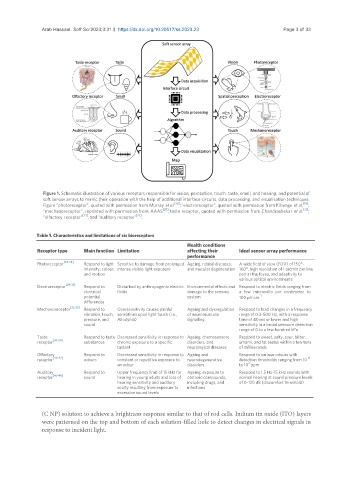
                Figure 1. Schematic illustration of various receptors responsible for vision, perception, touch, taste, smell, and hearing, and potential of
                soft sensor arrays to mimic their operation with the help of additional interface circuits, data processing, and visualisation techniques.
                Figure “photoreceptor”, quoted with permission from Murray et al. [18] ; “electroreceptor”, quoted with permission from Kibenge et al. [19] ;
                “mechanoreceptor”, reprinted with permission from  AAAS [20] ; taste receptor, quoted with permission from Chandrashekar  et al. [21] ;
                “olfactory receptor” [22] , and “auditory receptor” [23] .


             Table 1. Characteristics and limitations of six bioreceptors
                                                                Health conditions
              Receptor type  Main function Limitation           affecting their   Ideal sensor array performance
                                                                performance
              Photoreceptor [24-28]  Respond to light  Sensitive to damage from prolonged  Ageing, retinal diseases,   A wide field of view (FOV) of 150°-
                             intensity, colour,  intense visible light exposure  and macular degeneration 160°, high resolution of 1 arcmin per line
                             and motion                                           pair at the fovea, and adaptivity to
                                                                                  various optical environments
              Electroreceptor [29-31]  Respond to   Disturbed by anthropogenic electric  Environmental effects and  Respond to electric fields ranging from
                             electrical   fields                damage to the sensory   a  few  microvolts  per  centimetre  to
                             potential                          system            100 μV·cm -1
                             differences
                         [32-35]
              Mechanoreceptor  Respond to   Oversensitivity causes painful   Ageing and dysregulation  Respond to load changes in a frequency
                             vibration, touch,  sensations upon light touch (i.e.,   of neuromuscular   range of 0.3-500 Hz, with a response
                             pressure, and   Allodynia)         signalling        time of 40 ms or lower and high
                             sound                                                sensitivity in a broad pressure detection
                                                                                  range of 0 to a few hundred kPa
              Taste          Respond to taste  Decreased sensitivity in response to  Ageing, chemosensory   Respond to sweet, salty, sour, bitter,
                   [36-39]
              receptor       substances  chronic exposure to a specific   disorders, and   umami, and fat tastes within a few tens
                                         tastant                neurological diseases  of milliseconds
              Olfactory      Respond to   Decreased sensitivity in response to  Ageing and   Respond to various odours with
                   [40-42]                                                                               -6
              receptor       odours      constant or repetitive exposure to   neurodegenerative   detection thresholds ranging from 10
                                                                                     3
                                         an odour               disorders         to 10  ppm
              Auditory       Respond to   Upper frequency limit of 15 kHz for   Ageing, exposure to   Respond to 1.5 Hz-15 kHz sounds with
              receptor [43-46]  sound    hearing in young adults and loss of   ototoxic compounds,   normal hearing at sound pressure levels
                                         hearing sensitivity and auditory   including drugs, and   of 0-120 dB (discomfort threshold)
                                         acuity resulting from exposure to   infections
                                         excessive sound levels

               (C NP) solution to achieve a brightness response similar to that of rod cells. Indium tin oxide (ITO) layers
               were patterned on the top and bottom of each solution-filled hole to detect changes in electrical signals in
               response to incident light.

