


Page 106 - Read Online
P. 106
Xi et al. Soft Sci 2023;3:26  https://dx.doi.org/10.20517/ss.2023.13            Page 15 of 34


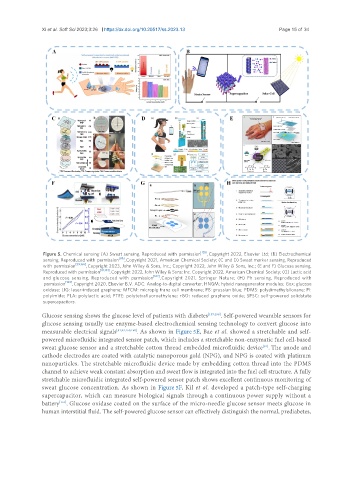
                Figure 5. Chemical sensing (A) Sweat sensing, Reproduced with  permission [155] , Copyright 2022, Elsevier Ltd; (B) Electrochemical
                sensing, Reproduced with  permission [86] , Copyright 2021, American Chemical Society; (C and D) Sweat marker sensing, Reproduced
                          [39,156]
                with  permission  , Copyright 2023, John Wiley & Sons, Inc.; Copyright 2022, John Wiley & Sons, Inc.; (E and F) Glucose sensing,
                                   [81,161]
                Reproduced with permission  , Copyright 2022, John Wiley & Sons; Inc. Copyright 2022, American Chemical Society; (G) Lactic acid
                                                     [162]
                and  glucose  sensing,  Reproduced  with  permission  , Copyright  2021,  Springer  Nature;  (H)  Ph  sensing,  Reproduced  with
                       [163]
                permission  , Copyright 2020, Elsevier B.V. ADC: Analog-to-digital converter; HNGM: hybrid nanogenerator modules; Gox: glucose
                oxidase; LIG: laser-induced graphene; MFCM: micropig franz cell membrane; PB: prussian blue; PDMS: polydimethylsiloxane; PI:
                polyimide; PLA: polylactic acid; PTFE: polytetrafluoroethylene; rGO: reduced graphene oxide; SPSC: self-powered solidstate
                supercapacitors.
               Glucose sensing shows the glucose level of patients with diabetes [157,158] . Self-powered wearable sensors for
               glucose sensing usually use enzyme-based electrochemical sensing technology to convert glucose into
               measurable electrical signals [81,93,159,160] . As shown in Figure 5E, Bae et al. showed a stretchable and self-
               powered microfluidic integrated sensor patch, which includes a stretchable non-enzymatic fuel cell-based
               sweat glucose sensor and a stretchable cotton thread embedded microfluidic device . The anode and
                                                                                          [81]
               cathode electrodes are coated with catalytic nanoporous gold (NPG), and NPG is coated with platinum
               nanoparticles. The stretchable microfluidic device made by embedding cotton thread into the PDMS
               channel to achieve weak constant absorption and sweat flow is integrated into the fuel cell structure. A fully
               stretchable microfluidic integrated self-powered sensor patch shows excellent continuous monitoring of
               sweat glucose concentration. As shown in Figure 5F, Kil et al. developed a patch-type self-charging
               supercapacitor, which can measure biological signals through a continuous power supply without a
               battery . Glucose oxidase coated on the surface of the micro-needle glucose sensor meets glucose in
                     [161]
               human interstitial fluid. The self-powered glucose sensor can effectively distinguish the normal, prediabetes,

