


Page 110 - Read Online
P. 110
Xi et al. Soft Sci 2023;3:26  https://dx.doi.org/10.20517/ss.2023.13            Page 19 of 34


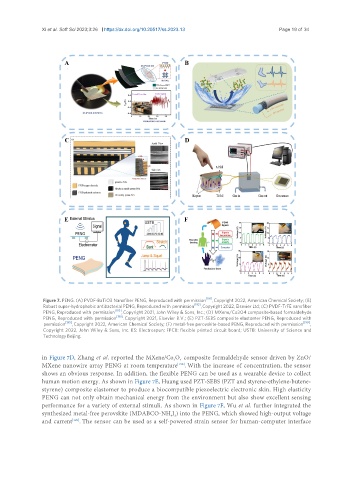
                Figure 7. PENG. (A) PVDF-BaTiO3 Nanofiber PENG, Reproduced with permission [191] , Copyright 2022, American Chemical Society; (B)
                Robust super-hydrophobic antibacterial PENG, Reproduced with permission [192] , Copyright 2022, Elsevier Ltd; (C) PVDF-TrFE nanofiber
                PENG, Reproduced with  permission [193] , Copyright 2021, John Wiley & Sons, Inc.; (D) MXene/Co3O4 composite-based formaldehyde
                PENG, Reproduced with  permission [198] . Copyright 2021, Elsevier B.V.; (E) PZT-SEBS composite elastomer PENG, Reproduced with
                       [185]                                                                           [199]
                permission  , Copyright 2022, American Chemical Society; (F) metal-free perovskite-based PENG, Reproduced with  permission  ,
                Copyright 2022, John Wiley & Sons, Inc. ES: Electrospun; FPCB: flexible printed circuit board; USTB: University of Science and
                Technology Beijing.

               in Figure 7D, Zhang et al. reported the MXene/Co O  composite formaldehyde sensor driven by ZnO/
                                                            3
                                                              4
                                                             [198]
               MXene nanowire array PENG at room temperature . With the increase of concentration, the sensor
               shows an obvious response. In addition, the flexible PENG can be used as a wearable device to collect
               human motion energy. As shown in Figure 7E, Huang used PZT-SEBS (PZT and styrene-ethylene-butene-
               styrene) composite elastomer to produce a biocompatible piezoelectric electronic skin. High elasticity
               PENG can not only obtain mechanical energy from the environment but also show excellent sensing
               performance for a variety of external stimuli. As shown in Figure 7F, Wu et al. further integrated the
               synthesized metal-free perovskite (MDABCO-NH I ) into the PENG, which showed high-output voltage
                                                           4 3
               and current . The sensor can be used as a self-powered strain sensor for human-computer interface
                         [199]

